The Premier League finally returns to action this weekend after a long break, with Matchweek 32 marking the beginning of the final stretch of the season. This week, we take a deep dive into the upcoming clash between Sunderland and Tottenham Hotspur, where newly appointed Spurs manager Roberto De Zerbi will take charge of his first match. Below is a full pre-match breakdown, including team news, injuries, predicted starting lineups, a Sunderland vs Tottenham prediction, and key stats. Roberto De Zerbi’s first match in charge should bring the entertainment.

Sunderland vs Tottenham Match Details
- Competition: Premier League
- Round: 32
- Date: Sunday, April 12, 2026
- Venue: Stadium of Light (Sunderland)
- Kickoff Time: 2:00pm (BST)
Sunderland Team News
Sunderland enter this match off the back of a dramatic last-minute winner away against Tyne-Wear derby rivals Newcastle United in their previous outing. That result will provide a significant confidence boost heading into this fixture. Notably, Sunderland have not played since the Premier League’s last matchday on Sunday, March 22nd, meaning they have had an extended break to recover and prepare.
With this time off, Sunderland supporters will be hoping for the return of several injured squad members. In particular, Dan Ballard and Robin Roefs both missed the derby victory against Newcastle. While both players remain questionable for this weekend’s match against Tottenham, there is optimism among the coaching staff and fans that they could return and strengthen the side.
Tottenham Team News
A great deal has changed for Tottenham since their last match in March. The club made the decision to sack Igor Tudor after just seven matches in charge, replacing him with Roberto De Zerbi. The appointment has been widely viewed as a risky one, particularly given the length and value of the contract handed to the Italian manager.
De Zerbi has signed a five-year deal with Spurs worth a reported £60 million, equating to £12 million per year and £1 million per month. The club will be hoping that this significant investment pays off as they battle to remain in the Premier League.
Tottenham’s most recent result was a 3–0 defeat to fellow relegation-threatened side Nottingham Forest. That loss leaves Spurs sitting 17th in the table on 30 points, just one point above relegation-placed West Ham United. As a result, the squad will need to adapt very quickly to De Zerbi’s complex and demanding tactical approach if they are to have any chance of survival this season.
There is some positive news on the injury front, as Mohammed Kudus has been spotted in training ahead of this weekend’s match. His potential return would be a significant boost, as he has not featured since Sunday, January 4th, when he picked up an injury against Sunderland.
However, there are also concerns. Guglielmo Vicario recently underwent minor surgery for a hernia and has been listed as questionable for this match. Despite this, it appears unlikely that he will be fully fit in time, which would leave Antonín Kinský as the most probable option in goal. Kinský has not featured since his difficult performance against Atlético Madrid under Igor Tudor.
IMPORTANT UPDATE: Mohammed Kudus has allegedly suffered another injury setback and is now expected to MISS the remainder of the Premier League season. Kudus will not be available for the match on Sunday.
Sunderland Injuries
Unavailable: Romain Mundle, Jocelin Ta Bi, Bertrand Traoré, Nilson Angulo
Questionable: Robin Roefs, Dan Ballard
Tottenham Injuries
Unavailable: Wilson Odobert, Dejan Kulusevski, James Maddison, Ben Davies, Yves Bissouma, Mohammed Kudus
Questionable: Guglielmo Vicario, Pape Matar Sarr, Rodrigo Bentancur
Predicted Starting Lineups
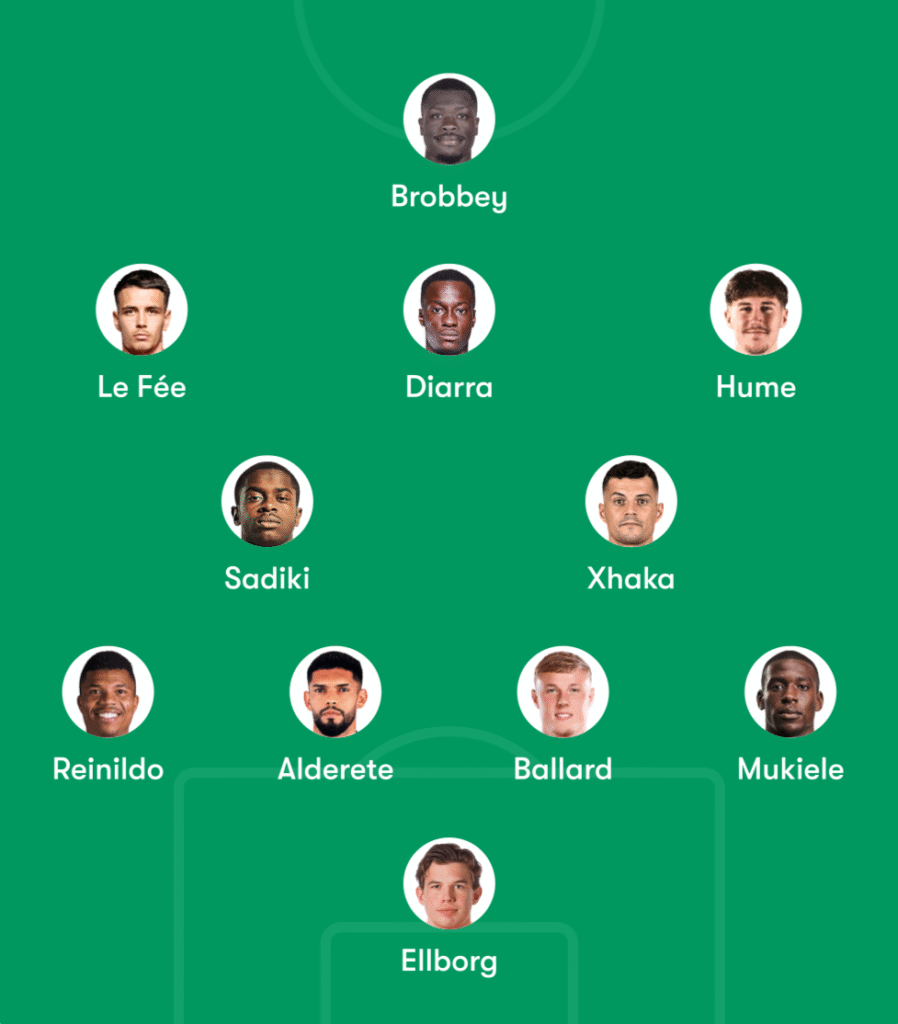
Sunderland Lineup Notes:
With Robin Roefs still a doubt, Melker Ellborg could once again be called upon to start in goal for Sunderland. His inclusion would provide continuity if Roefs is not deemed fit enough to return.
Régis Le Bris is also expected to benefit from the return of Reinildo at left-back. This could allow Trai Hume to push further forward, potentially returning to a more advanced role on the right wing.
In central midfield, Granit Xhaka and Sadiki are likely to take up their usual roles as the double pivot. Their presence will be key in maintaining structure and control in the middle of the pitch.
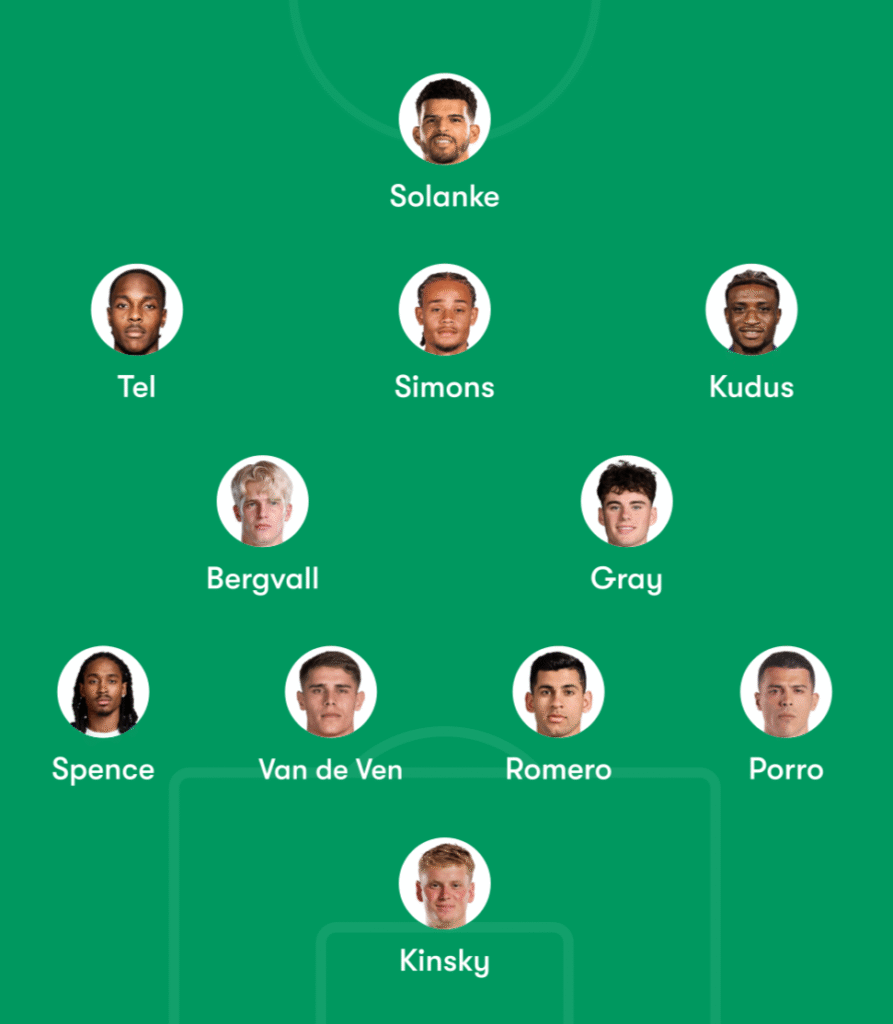
Tottenham Lineup Notes:
There remains a great deal of uncertainty surrounding Roberto De Zerbi’s first starting lineup as Tottenham manager. However, a 4-2-3-1 formation appears to be the most likely setup based on his previous tactical preferences.
If Guglielmo Vicario is unavailable, Antonín Kinský is expected to step in as the starting goalkeeper. This would mark his return to the side following his previous appearance against Atlético Madrid in the UEFA Champions League.
De Zerbi will be particularly hopeful for the return of Mohammed Kudus, as his ability to take on defenders in one-on-one situations aligns perfectly with the Italian manager’s tactical philosophy.
In central midfield, De Zerbi could turn to young talents Archie Gray and Lucas Bergvall. However, there is also the possibility that one of these players is paired with a more experienced option such as Pape Matar Sarr, João Palhinha, or Rodrigo Bentancur, depending on fitness and availability. Including a more experienced midfielder could provide additional stability in the centre of the pitch.
Leading the line, Dominic Solanke is expected to be De Zerbi’s preferred choice. His physical presence and ability to hold up the ball with his back to goal make him well-suited to the demands of the role.
UPDATE: Kudus has been ruled out. Randal Kolo Muani is the most likely replacement down the right wing for De Zerbi’s first match in charge of Spurs.
Sunderland vs Tottenham Preview
A number of questions surround Roberto De Zerbi and Tottenham Hotspur heading into their first match under his management. With only seven league umatches remaining, Spurs must find form quickly and adapt to De Zerbi’s tactical demands, particularly with the threat of relegation looming. This fixture presents an intriguing tactical battle, with uncertainty on one side and a clearly defined structure on the other.
Sunderland Tactical Analysis
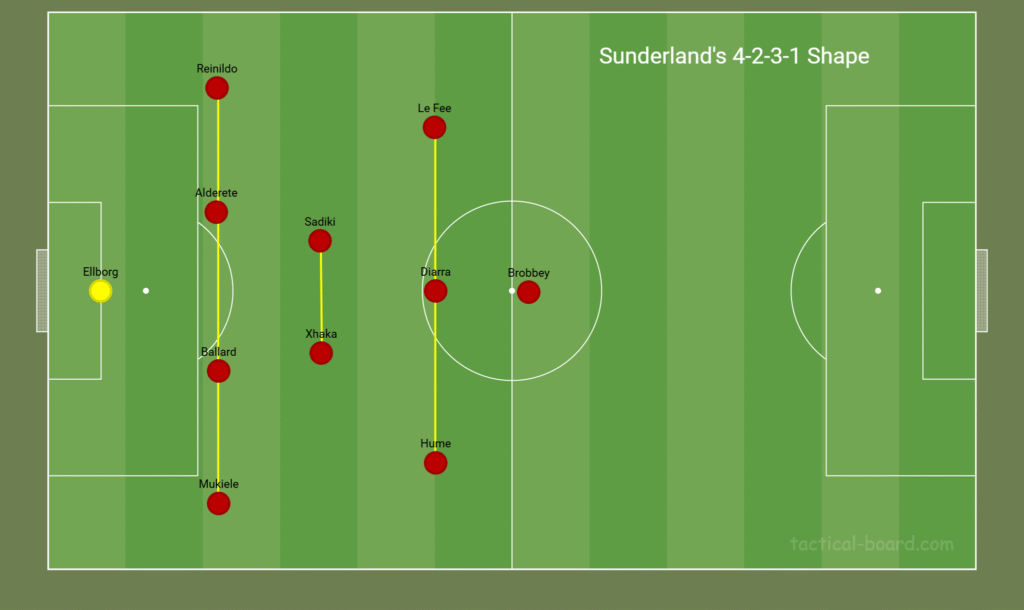
On paper, Sunderland line up in a 4-2-3-1 formation, though their shape is fluid and shifts throughout the different phases of play.
Sunderland Out of Possession
When transitioning out of possession, Sunderland often move into a 4-4-2 high block.
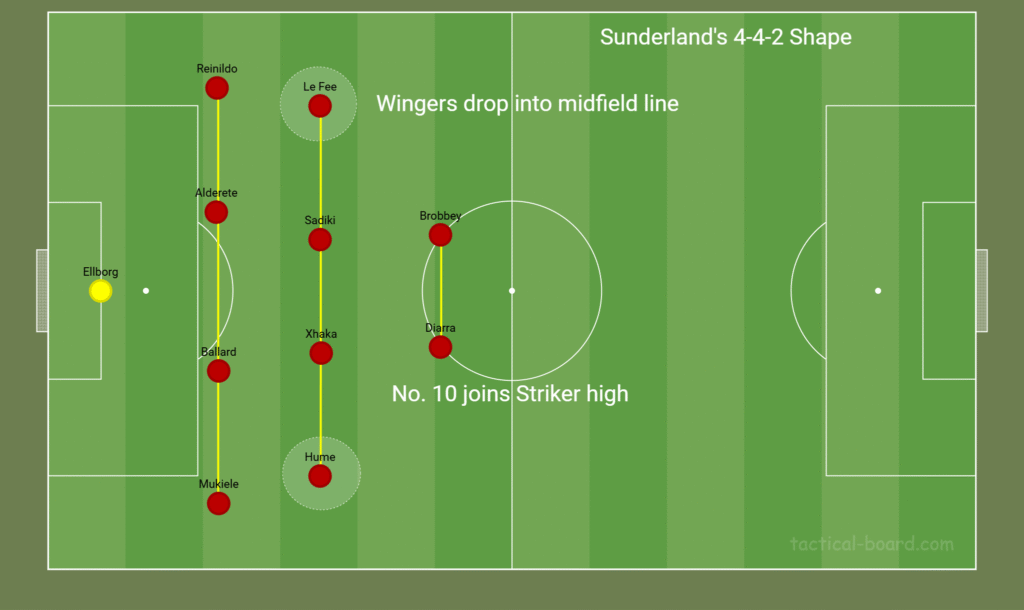
In this shape, the wingers drop into the midfield line to defend the wide areas, while the number 10, Diarra, pushes forward to join Brobbey in the first line of defence. This allows Sunderland to apply pressure to the opposition back line while still maintaining defensive compactness behind.
Trai Hume’s role on the wing out of possession is a particularly important aspect of Sunderland’s structure. With Reinildo available again at left-back, Hume has the opportunity to start higher up the pitch if Régis Le Bris opts to use him there. Hume’s versatility is a key asset, as he has featured at left wing, left-back, right wing, and right-back this season. When Sunderland drop into a low block, Hume can transition into the defensive line, effectively turning a back four into a back five. This added defensive flexibility allows Sunderland to better protect central areas and deal with sustained pressure.
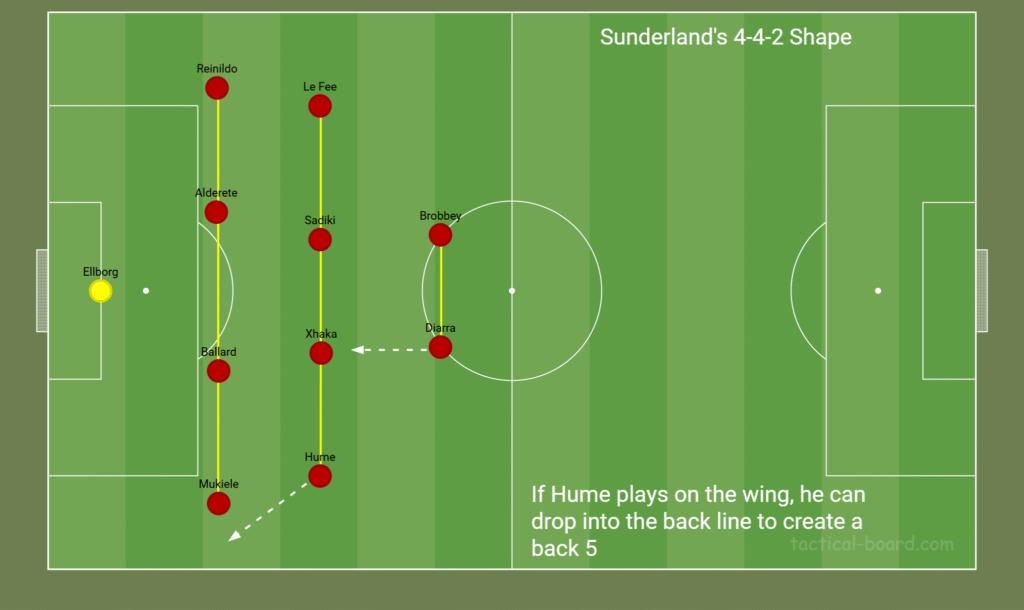
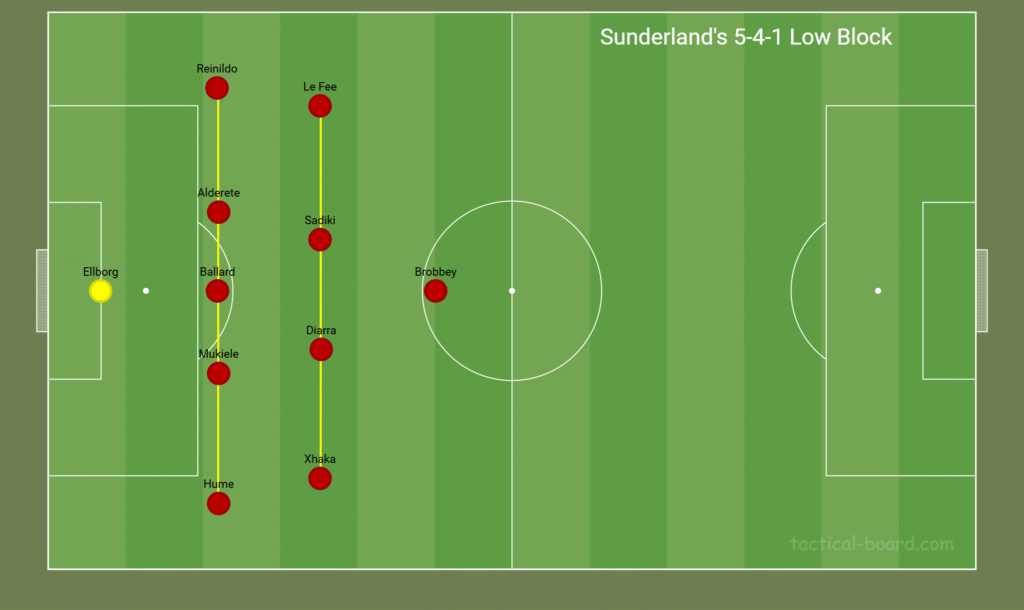
Sunderland aim to remain compact centrally and deny their opponents space in key areas of the pitch. The ability to drop Hume into the back line while shifting Mukiele into a more central defensive role can be crucial in maintaining this compactness. This defensive adaptability may prove vital in limiting Tottenham’s attacking opportunities.
Sunderland’s Press
Roberto De Zerbi is widely known for his tactical philosophy of encouraging movement in response to the opposition. His teams are structured in possession to invite pressure, drawing opponents forward before exploiting the spaces created through fluid passing sequences. Because of this, Sunderland may be cautious about committing too aggressively to a high press.
If Sunderland do choose to press high, it remains unclear how Tottenham will respond, given that this will be their first match under De Zerbi. The Italian has had limited time to implement his tactical ideas, and it is possible that Spurs are not yet fully prepared to consistently build out from the back under pressure.
Another key factor in Sunderland’s pressing approach will be the identity of Tottenham’s starting goalkeeper. Following Antonín Kinský’s difficult performance against Atlético Madrid, Sunderland may see an opportunity. If Kinský starts and Tottenham attempt to build from the back, Régis Le Bris could instruct his side to press aggressively in order to force errors and create turnovers in dangerous areas.
Overall, Sunderland’s pressing intensity and structure may evolve throughout the match. Their approach will likely depend on several variables, including Tottenham’s build-up patterns, the effectiveness of their own press, and the personnel selected by Spurs – particularly in goal.
Sunderland in Attack
At times, Sunderland have shown a tendency to overcommit during the build-up phase. Ellborg, in particular, has not always appeared comfortable with the ball at his feet, which was evident in their previous match against Newcastle United. For Newcastle’s opening goal, Ellborg attempted to play the ball centrally under pressure, but a high press combined with a misplaced pass led to a quick turnover and a goal from Anthony Gordon. If Robin Roefs remains unavailable and Ellborg starts again, Sunderland may benefit from bypassing short build-up play and opting for a more direct approach from the back.
In possession in the attacking half, Sunderland’s shape becomes more dynamic and can transition into multiple structures depending on the situation.
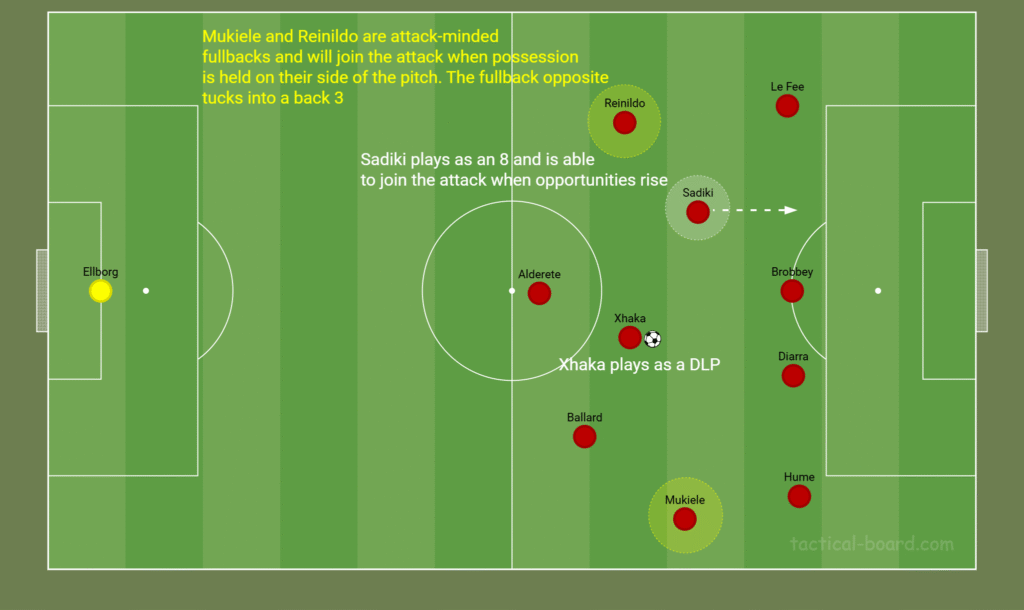
Mukiele and Reinildo, both attack-minded full-backs, will push forward to support attacks on their respective sides. When this happens, the full-back on the opposite side may tuck inside to form a back three or invert into midfield, allowing Sadiki to advance further forward.
Sadiki operates primarily as a number 8 and has the freedom to either hold his position in midfield or push higher into attacking areas, where he can roam and influence play. Meanwhile, Granit Xhaka functions as a deep-lying playmaker, dictating tempo and distributing the ball from deeper positions.
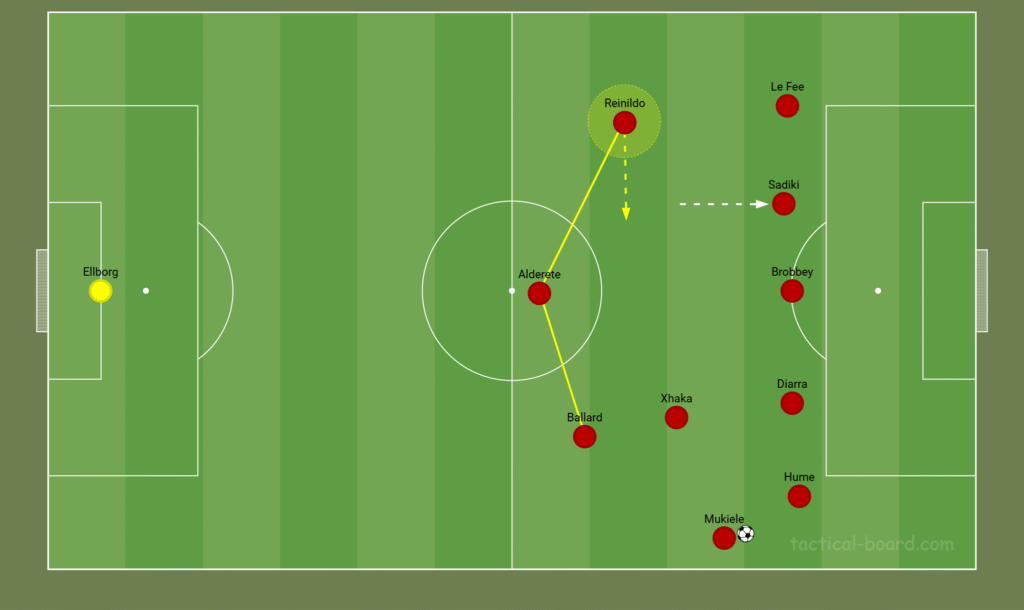
When attacking down the flanks, Sunderland look to overload the wide areas. By shifting numbers toward the side of play, they aim to draw opposition players out of central positions, creating space that can be exploited through crosses or penetrative passing lanes.
Tottenham Tactical Setup Under De Zerbi
As this will be Tottenham’s first match under Roberto De Zerbi, there remains significant uncertainty regarding how the team will set up. However, based on his previous managerial roles, certain tactical tendencies can be expected.
Tottenham are likely to line up in a 4-2-3-1 formation, with full-backs operating in narrower positions and having the ability to advance into the half-spaces during attacking phases. The two central midfielders will form a double pivot, providing a base for both build-up play and defensive stability.
During the build-up phase, De Zerbi typically instructs his central defenders to spread wide while incorporating the goalkeeper into possession. This creates additional passing angles and helps draw the opposition forward. The double pivot in midfield offers support and passing options, while the wingers maintain width to stretch the opposition’s defensive shape.
Further forward, the number 10, Xavi Simons, is expected to push high and operate close to the forward line, effectively forming a line of four in advanced areas. This positioning allows for greater attacking presence and fluid movement in the final third.
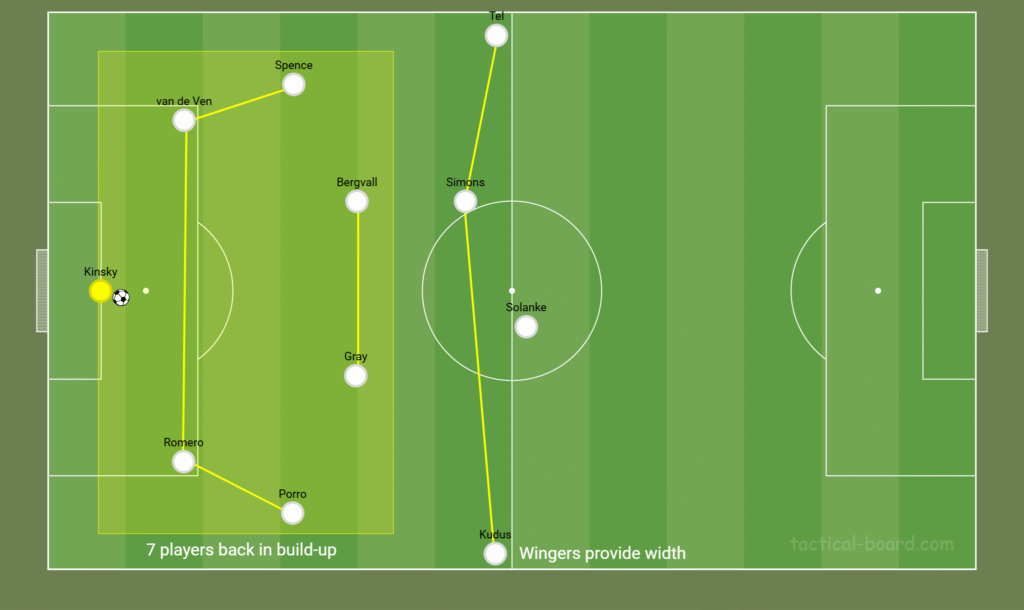
This build-up structure allows Tottenham to maintain seven players deeper in the initial phases of possession, providing stability and multiple passing options when progressing the ball from the back. By committing more players to the build-up, Spurs can better circulate possession and resist pressure, while still having options ahead of the ball.
However, De Zerbi may need to take a more cautious approach, particularly if Antonín Kinský starts in goal. Given Kinský’s previous struggles, it would be advisable for Tottenham to avoid building out from the back immediately. Instead, allowing the young goalkeeper to settle into the match without being placed under early pressure could be crucial. In this scenario, Spurs may benefit from adopting a more direct approach in the early stages, opting to play long from the back rather than risk turnovers in dangerous areas.
De Zerbi will ultimately want his Tottenham side to play with a high level of fluidity, with players constantly rotating positions, moving into space, and creating open passing lanes. This movement is central to his tactical philosophy, as it disrupts defensive structures and opens up opportunities to progress the ball through the thirds.
In wider areas, Tottenham’s full-backs are expected to operate in narrower positions, allowing the wingers to hold the width. This setup is designed to isolate opposing full-backs and create one-on-one situations, where Tottenham’s wide players can take on their defenders and generate attacking opportunities.
The role of the full-backs will be particularly flexible within this system. At times, they may remain deeper, forming part of a back three during attacking phases to provide defensive security. Alternatively, they can invert into central midfield to support the build-up and create numerical superiority in the middle of the pitch. In other moments, they may push higher up the field, making underlapping runs inside the wingers to add an extra attacking dimension.
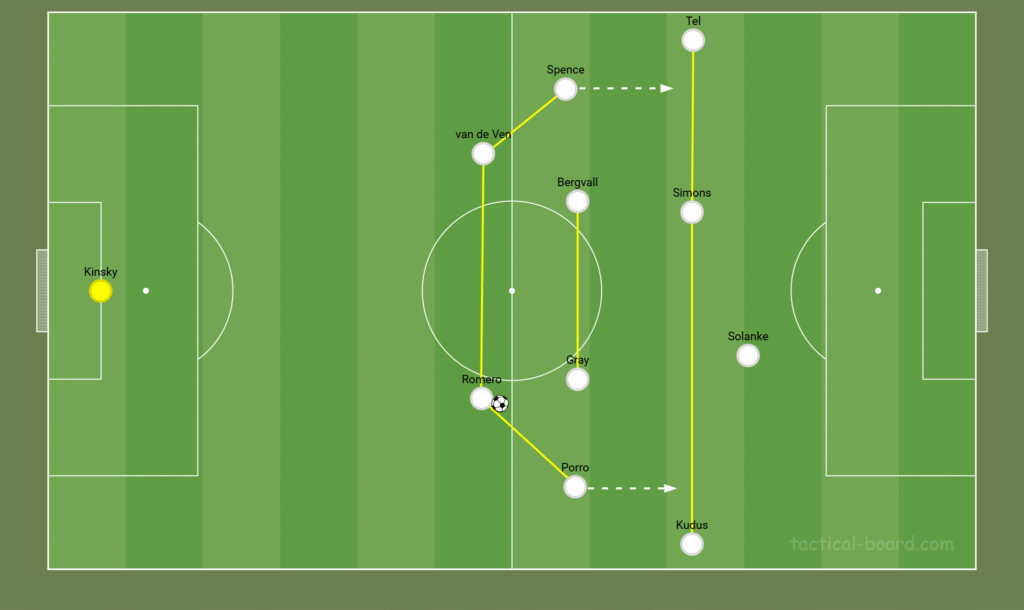
Inverted full-backs can play a key role in Tottenham’s approach, particularly in helping to overload central midfield areas. By moving inside, they can create numerical advantages in the middle of the pitch while also opening additional passing lanes through central zones, making it easier to progress the ball and break through compact defensive structures.
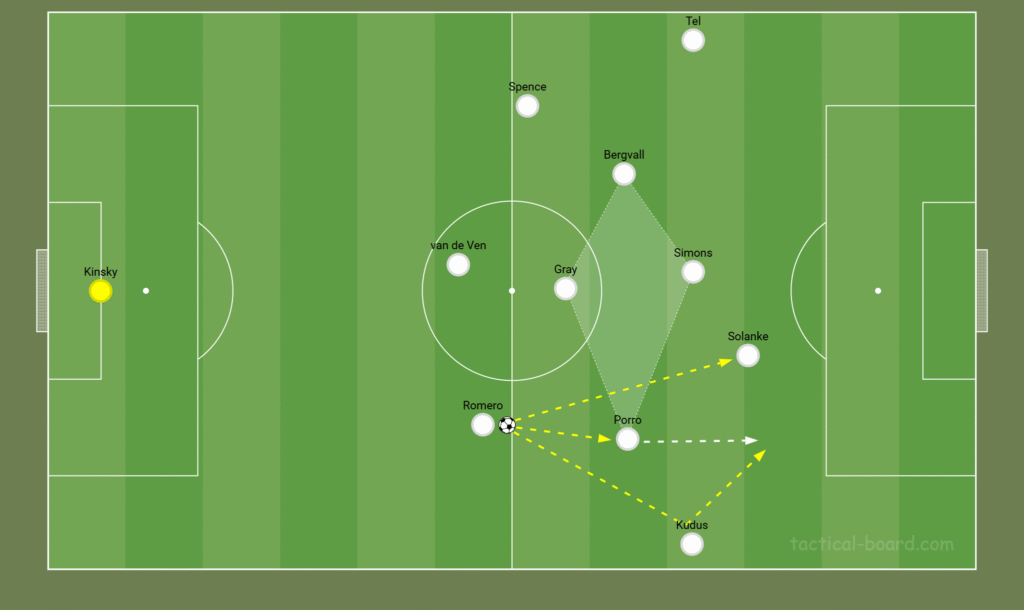
Tottenham are also likely to utilize a high number of decoy runs throughout the match. These movements are designed to pull defenders out of position and create space for teammates, allowing Spurs to exploit gaps that open up as a result of this off-the-ball movement.
Xavi Simons, operating in the number 10 role, will be central to linking midfield and attack. Positioned between the opposition’s defensive and midfield lines, he will be tasked with receiving the ball in tight spaces, turning, and facilitating forward play. His ability to operate between the lines will be crucial in breaking down Sunderland’s defensive shape.
From Sunderland’s perspective, maintaining their defensive structure will be essential. Rather than committing to man-marking, they should look to hold their shape and remain compact. By doing so, they can force Tottenham to move the ball around them and search for openings, rather than allowing Spurs to drag players out of position and play through disorganized defensive lines.
Ultimately, Sunderland’s best route to success defensively may lie in their discipline and structural stability. By staying compact, congesting central areas, and making themselves difficult to break down, they can limit Tottenham’s ability to create clear-cut chances.
Sunderland vs Tottenham Prediction
This is a very difficult match to predict, particularly without having seen Tottenham play under Roberto De Zerbi.
Win probability metrics suggest Sunderland have a 43% chance of victory, while Tottenham are given a 30% chance, and a draw is rated at 27%.
- To view win probabilities for all Premier League matches, click here!
I am leaning towards a draw. De Zerbi has not had much time with his new squad, and it remains unclear how quickly the players will adapt to his tactical approach and style of play. While De Zerbi is a strong manager, it would not be surprising if his initial priority is stability and avoiding mistakes in his first match in charge.
Sunderland, on the other hand, have generally performed well at home this season, although they have shown some inconsistency in recent matches at the Stadium of Light. Given the context of the fixture, Sunderland are likely to adopt a more cautious, defensively focused approach and allow the game to develop rather than forcing the issue.
Prediction: 1-1 draw
References: fbref, FotMob, Premier League