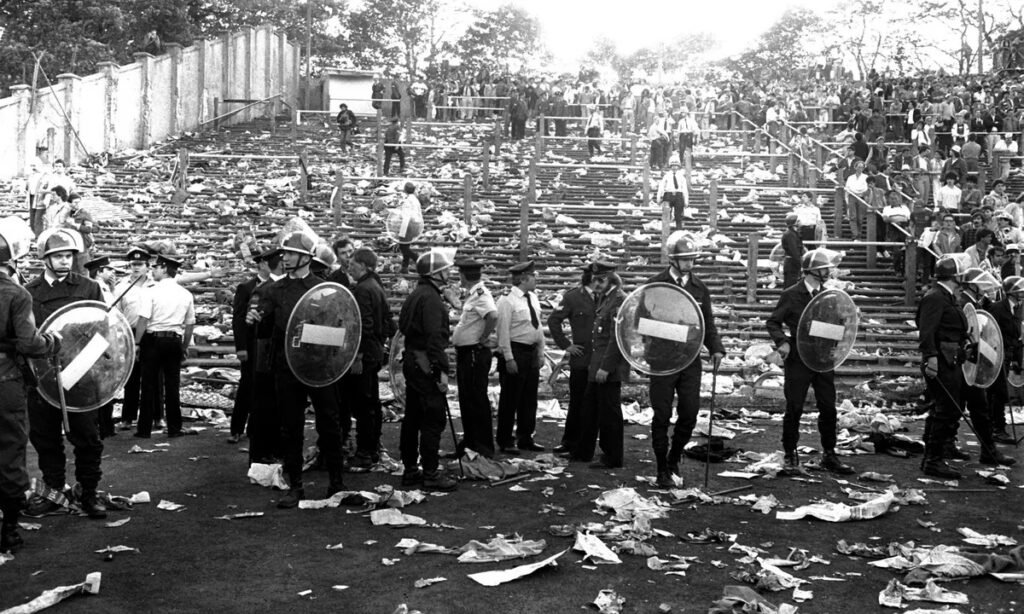
West Ham United and Millwall meet again this season for the first time in fourteen years, renewing a rivalry that started on the banks of the Thames in the 1890s and has produced some of the ugliest, saddest, and strangest chapters in English football history. This is the long version — the docks, the firms, the deaths, and the numbers behind one of the game’s oldest grudges.
West Ham vs Millwall Head-to-Head — The Numbers
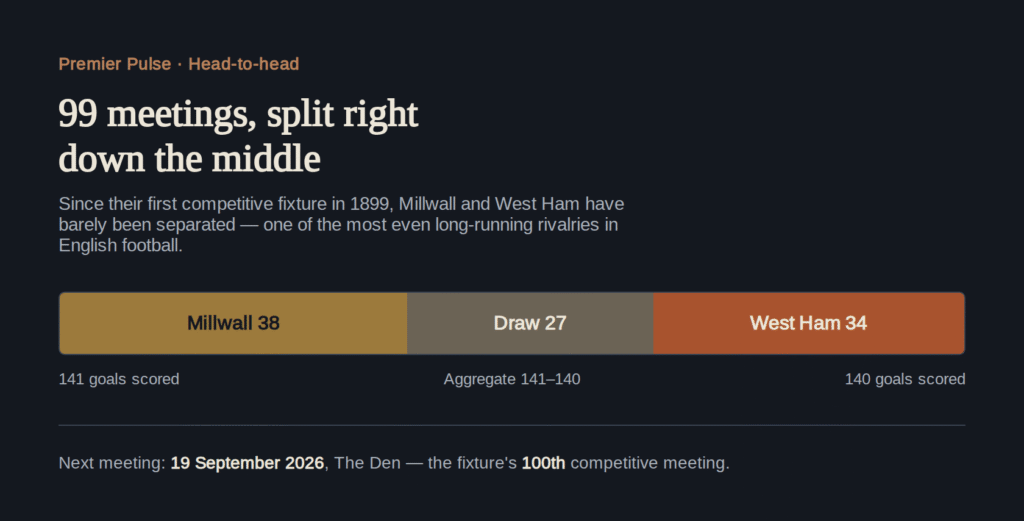
Across 99 competitive meetings since 1899, this is about as even a rivalry as English football has to offer: Millwall have won 38, West Ham 34, and 27 have been drawn, with Millwall holding a wafer-thin 141–140 lead on goals scored.
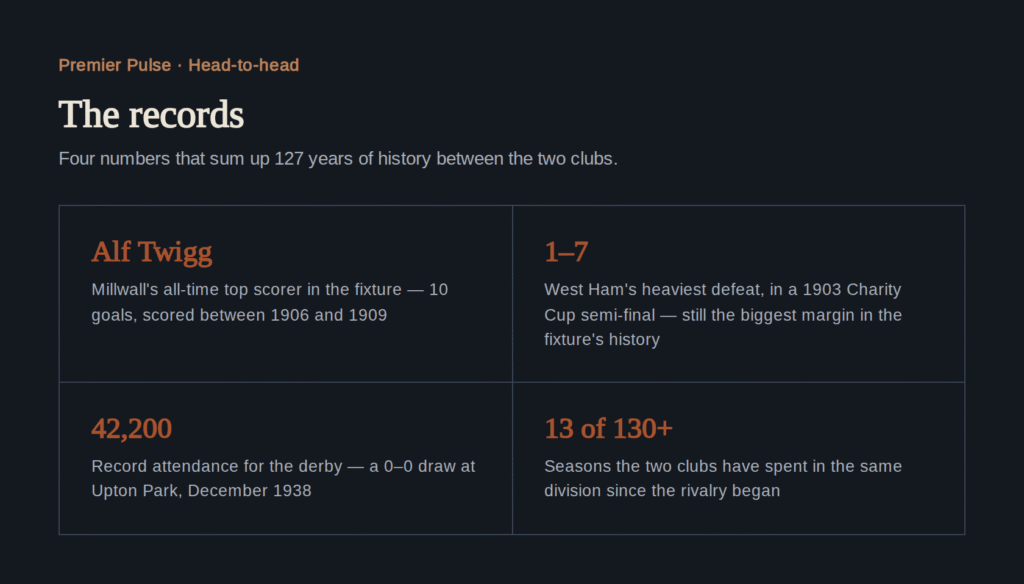
Millwall’s Alf Twigg is the fixture’s all-time top scorer with 10 goals, all struck between 1906 and 1909. West Ham’s heaviest defeat — the 1–7 loss in the April 1903 Charity Cup semi-final already mentioned above — remains the biggest winning margin either side has recorded.
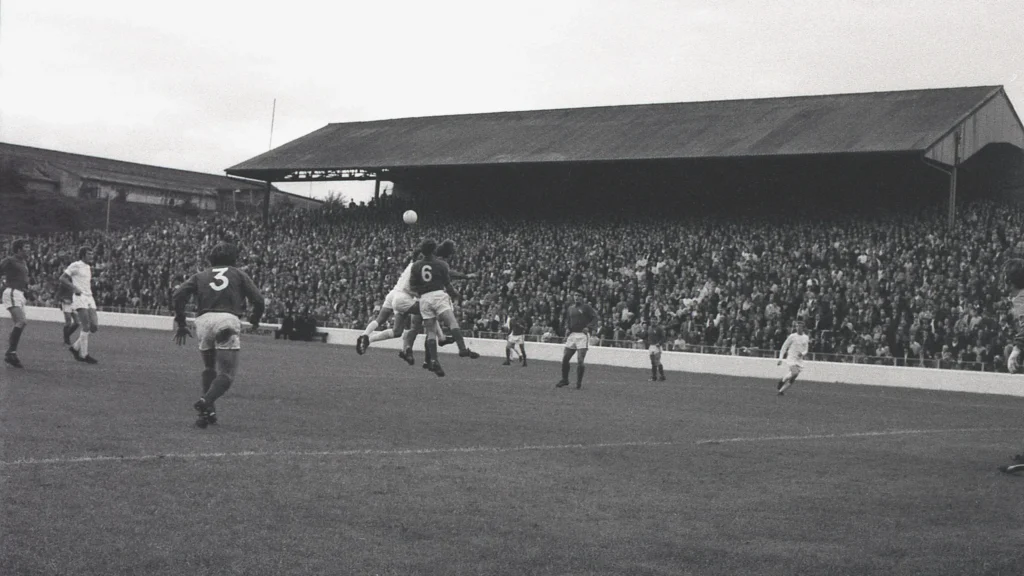
The record attendance for the derby, 42,200, came to a goalless draw at Upton Park in December 1938. Despite the intensity of the fixture, the two clubs have actually shared a division for only 13 of the more than 130 seasons since the rivalry began — most of the enmity has been sustained across different tiers of the pyramid, which if anything says something about how little the football itself has to do with why this rivalry endures.
A Rivalry Born on the Docks
Long before either club had a trophy cabinet, they had a grievance.
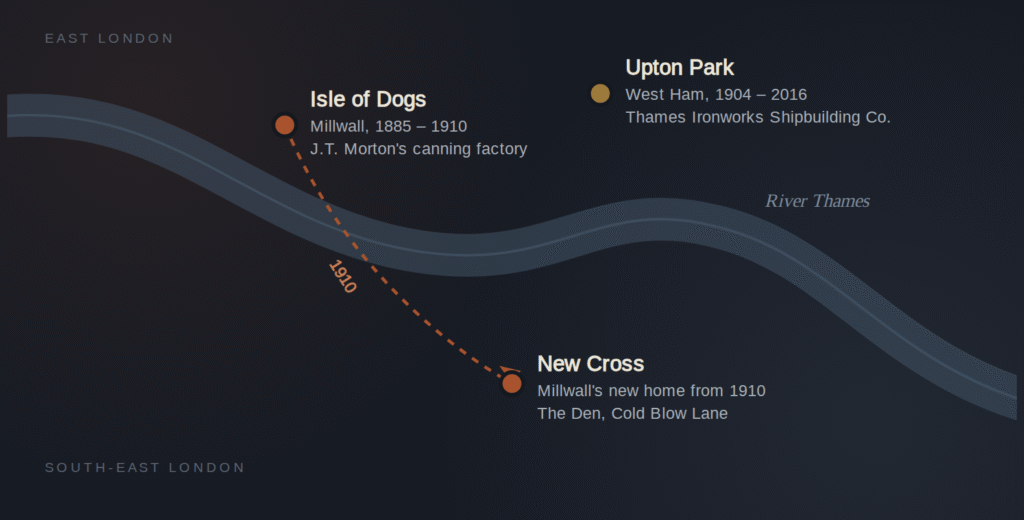
Millwall’s story starts in 1885, when tinsmiths at J.T. Morton’s canning and preserve factory on the Isle of Dogs formed Millwall Rovers, drawing much of their early squad from Scottish workers who had relocated from Dundee.
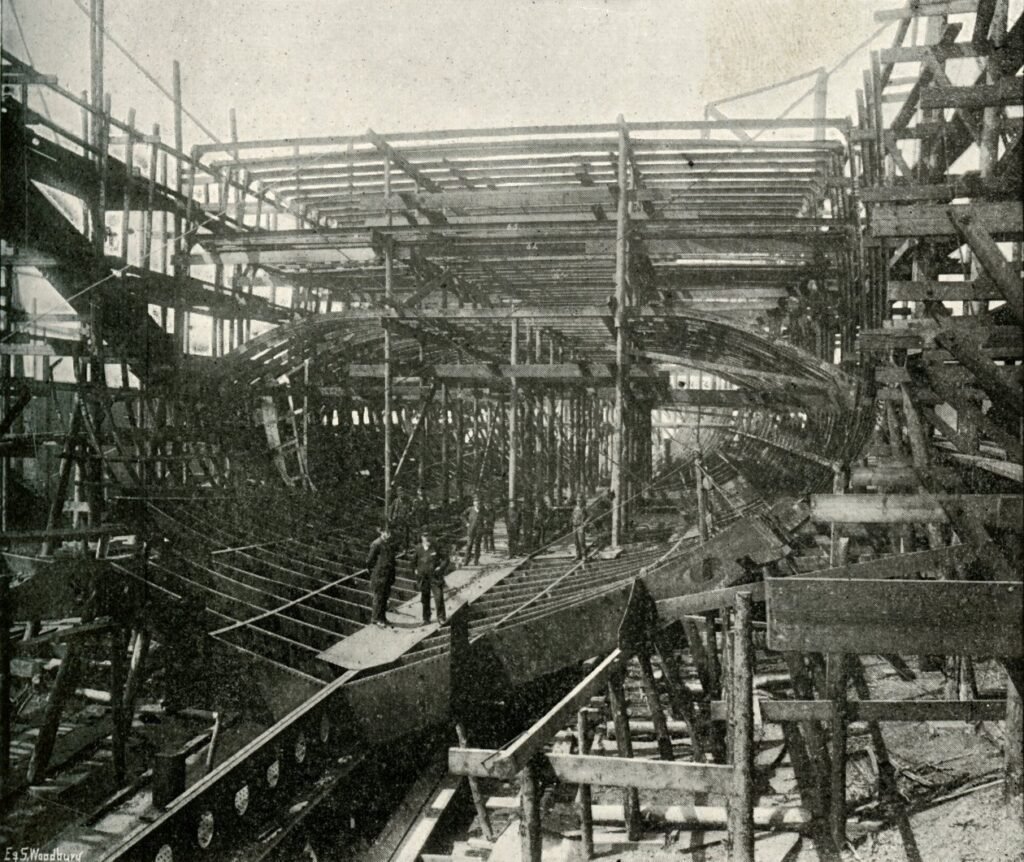
A decade later, in 1895, a foreman at the Thames Ironworks and Shipbuilding Company named Dave Taylor put together a works team to lift morale among the yard’s laborers, backed by company owner Arnold Hills. That side folded in June 1900 amid boardroom disputes over how the club should be run, and was relaunched within weeks as West Ham United — the “Hammers” nickname a direct reference to the tools of the shipyard.
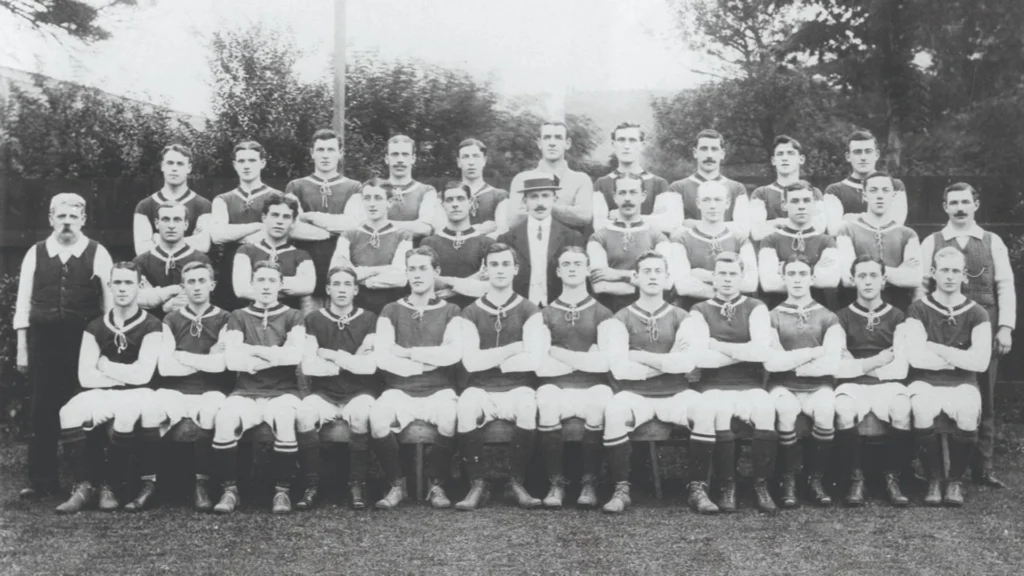
Both clubs’ original support was drawn from dockers and shipyard workers employed by firms that were, quite literally, competing for the same contracts along the same stretch of river. The football pitch became an extension of that economic rivalry from the very start. The clubs’ first-ever meeting, a friendly on 23 September 1897, went to Millwall Athletic 2–0. Their first competitive fixture — a Fifth Round FA Cup qualifier on 9 December 1899 — also went Millwall’s way, 2–1, with goals from Hugh Goldie and Bert Banks. Millwall went on to reach the semi-final of that season’s FA Cup before losing to Southampton, and a newspaper headline dubbing them “The Lions of the South” gave the club its enduring nickname.
Between that first meeting and the outbreak of the First World War, the two sides met an almost absurd sixty times in sixteen years — mostly in regional competitions like the Southern League, Western League and London League, at a frequency the fixture has never come close to matching since. Millwall had the better of it by some distance in these early years: a run of twelve games unbeaten between April 1902 and September 1904 included a 7–1 win in the 1903 Southern Professional Charity Cup semi-final, still the largest winning margin either side has ever managed in the fixture’s history, with Ben Hulse scoring four of the goals.
The first documented flashpoint between the two sets of supporters came on 17 September 1906, in a Western League match at Upton Park. Two Millwall players were sent off after a heavy collision between Millwall’s Alf Dean and West Ham’s Len Jarvis, in which Dean was hurled into a metal advertising hoarding. The local paper, the East Ham Echo, reported that trouble had looked likely from the first kick, and that the sending-offs “aroused considerable excitement among the spectators,” with “free fights” breaking out on the terraces. It’s a small, easily overlooked incident, but it’s the earliest recorded moment where the rivalry’s intensity spilled from the stands onto the pitch and back — a pattern that would repeat for the next century.
Crossing the River
In 1910, with no room to expand on the Isle of Dogs, Millwall dropped “Athletic” from their name and moved four miles south to a new ground in New Cross, South East London, called The Den. It ended their run as literal East End neighbours of West Ham, but it didn’t cool the rivalry — if anything, the fixture took on an added “us versus them” geography that has stuck ever since, framed as much by which side of the Thames you were born on as by anything happening on the pitch.
The clubs played 33 times during the two World Wars, fielding depleted sides of reserves, juniors and “guest” professionals borrowed from other clubs — several players, including Sailor Brown, Louis Cardwell and Jimmy Jinks, turned out for both West Ham and Millwall during this period, which is a detail worth sitting with given what came later. When the Den was badly damaged by a German bomb in April 1943 and a fire a week later destroyed an entire stand, Millwall’s neighbours — Charlton Athletic, Crystal Palace, and West Ham — all offered their grounds so Millwall could keep playing. Whatever the rivalry became, it began, at least during wartime, with a degree of mutual aid that later generations of supporters would find almost unrecognisable.
The Quiet Disorder — the 1930s to the 1950s
It’s worth being precise about what is and isn’t documented in this stretch, because the picture is messier than the popular “hooliganism started in the 1970s” narrative suggests.
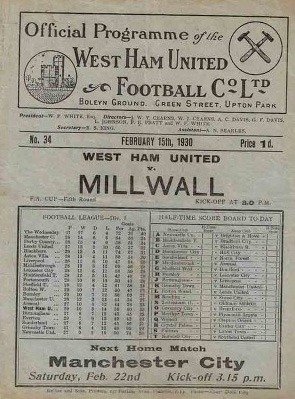
The first derby-specific incident on record is from 15 February 1930, when West Ham beat Millwall 4–1 in an FA Cup fifth-round tie at Upton Park in front of 24,000 fans — a match remembered, in part, for early crowd trouble in the stands, though nothing on the scale of what followed decades later.
What’s better documented in this period is Millwall’s wider disciplinary record, independent of any specific opponent. The Den was closed by the Football Association for two weeks in the early 1920s after a Newport County goalkeeper, struck by missiles thrown from the crowd, waded into the stands to confront supporters and was knocked unconscious. It was closed again in 1934 following disorder at a match against Bradford Park Avenue, and pitch invasions led to a further closure in 1947. In 1950, the club was fined after a referee and linesman were ambushed by fans outside the ground following a match. None of these incidents are recorded as being West Ham fixtures specifically — the surviving accounts don’t name the opponent in most cases — but they establish that Millwall’s problem with crowd control in this era wasn’t confined to games against their oldest rivals; it was a broader institutional issue that the FA kept coming back to punish.
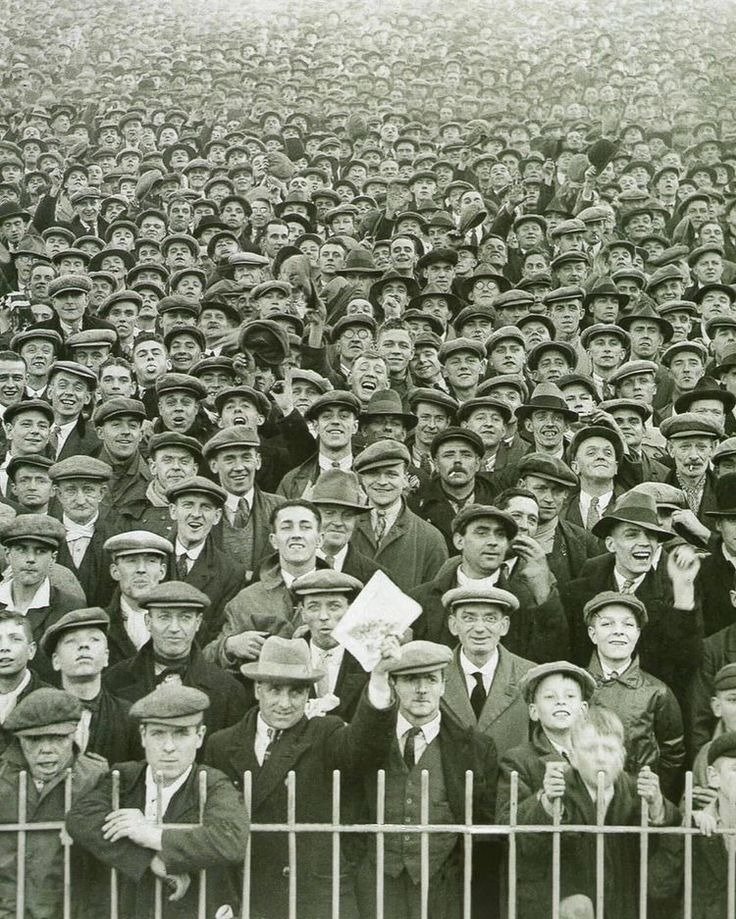
As for the derby itself in this window: the two clubs actually shared a division for the first time since before the war in 1946–47 and 1947–48, and met four times in quick succession — West Ham won 3–1 at Upton Park in September 1946 in front of 30,400 fans, then the sides drew 0–0 at The Den in January 1947 (22,082 attendance), 1–1 at Upton Park in August 1947 (25,000), and 1–1 again at The Den a week later (15,814). None of the surviving match reports from these specific fixtures single out crowd trouble, for what it’s worth — which suggests that, whatever was happening at Millwall more broadly in this era, this particular run of derbies passed largely without serious incident. The clubs met once more in a 1959 Southern Floodlight Cup tie (West Ham won 3–1) before an extraordinary 19-year gap opened up between meetings — the 1960s remains the only decade in the rivalry’s history in which the two sides never played each other at all.
If you want the fuller story of Millwall’s disciplinary history in this period and beyond — independent of West Ham — we’ve written about it in more depth here: Millwall’s hooliganism history: rise, fall and reckoning.
The Firms Emerge
Football hooliganism as it’s now understood — organised, named “firms” travelling to fight rather than just watch — took shape across English football in the late 1960s and through the 1970s, and few fixtures did more to define the phenomenon in the public imagination than this one.
Millwall’s firm has its roots in a group known as F-Troop, which formed around 1972 among a new, more organised generation of the club’s support; the “Millwall Bushwackers” name became attached to the same network through the rest of the decade and into the 1980s. The term “Millwall brick” — a tightly rolled and folded newspaper, hard enough to use as a weapon — dates from this era and entered wider British slang as shorthand for the club’s reputation. West Ham’s Inter City Firm formed slightly later, in the 1977–78 season, out of several existing groups including the Mile End Boys, and took its name from the InterCity trains its members used to travel to away games. The writer Cass Pennant, a former ICF figure, later described the two clubs’ relationship as being like brothers who share the same blood but who would still fight to the death over which of them gets to be king.
The gangland backdrop is part of this too. Michael Calvin, in his book Family: Life, Death and Football, traced the rivalry’s poison partly to earlier East End social history — strikebreaking, dockland labour disputes — and noted that it was given, in his words, a genuinely murderous dimension a generation later by the gang wars between the Krays (West Ham-aligned) and the Richardsons (Millwall-aligned) in the 1960s.
1972 — the Cripps testimonial.
A benefit match at The Den for Millwall’s long-serving defender Harry Cripps, who had begun his career at West Ham, should have been a low-stakes, good-natured occasion. Instead it was marred by organised fighting between the two clubs’ emerging firms, both inside and outside the ground — one of the first times the new, more violent culture on the terraces showed itself specifically in a West Ham–Millwall context.
1976 — The Death of Ian Pratt
The rivalry’s darkest chapter to that point came on an evening in September 1976, after a match at The Den. Ian Pratt was an 18-year-old Millwall supporter. Accounts of what happened next vary in their exact detail — some describe him snatching a scarf from a West Ham fan, others simply describe a confrontation between rival groups — but what’s agreed is that Pratt was chased by a group of West Ham supporters into New Cross railway station. He ended up on the tracks and was struck and killed by a train. Whether he fell while trying to escape or was pushed has never been definitively established in the accounts that survive; it remains one of the genuinely contested details of the story, more than the fact of his death.
What followed was uglier still. West Ham’s hooligan following turned the tragedy into a terrace chant almost immediately — “West Ham boys, we’ve got brains, we throw Millwall under trains” — sung, according to multiple accounts, for years afterward. Millwall’s support, for its part, did not simply grieve; they organised. It would be two more years before the sides played each other again, and Millwall fans used the wait.
It’s the hinge point the rest of the decade’s violence pivots around, but it’s worth remembering it was a real death, of a real 18-year-old, rather than just the terrace folklore it later became.
1978 — “A West Ham Fan Must Die”
West Ham’s relegation to the Second Division in 1978 finally brought the clubs back together, and Millwall’s support had spent two years waiting for this exact fixture. In the build-up, leaflets began circulating around the Cold Blow Lane end of The Den bearing a photograph of Ian Pratt and a written threat that a West Ham fan would have to die to avenge him.
The Metropolitan Police responded with what was, at the time, an unprecedented operation for a domestic football fixture: roughly 500 officers were deployed for the match at Upton Park on 7 October 1978, enforcing strict segregation and thorough searches of supporters. West Ham won the game 3–0. Even with the scale of the policing operation, six officers were injured and around 70 people were arrested in clashes in the surrounding streets, with a number of weapons seized. It’s genuinely hard to overstate how far the threat of violence around this specific fixture had escalated in just six years, from a testimonial match scuffle in 1972 to a five-hundred-officer operation in 1978.
1979 – Millwall Finally Win
The following May, Millwall beat West Ham 2–1 at The Den, ending a winless run against their rivals stretching back an extraordinary 46 years, to 1933 — Pop Robson had given West Ham a half-time lead before goals from Dave Mehmet and Nicky Chatterton turned it around.
1986 — The Murder of Terry Burns
More than seven years passed without the clubs meeting again after 1979 — but on 4 October 1986, the rivalry claimed a second life, and this time no match was even being played. Terry Burns, a 19-year-old West Ham supporter, was stabbed to death by a group of Millwall fans on Villiers Street, next to Embankment Underground station in central London. It stands as one of the grimmest facts of this entire rivalry: that violence between the two sets of supporters could still erupt, fatally, in a year when West Ham and Millwall weren’t even in the same division and had no fixture against each other scheduled.
1987 – Millwall’s Last Away Day Win
The following November brought a rare moment of pure footballing history amid the darkness: a 2–1 Millwall win in the Full Members’ Cup gave the visitors their first victory at Upton Park in 73 years — Alan Dickens had given West Ham the lead before two goals in three minutes from Teddy Sheringham and Tony Cascarino turned the game. It remains, to this day, Millwall’s last away win in the fixture.
1988–89
In the only season the two clubs have ever shared the old First Division — English football’s top flight before the Premier League existed — West Ham beat Millwall both home and away, a 1–0 win at The Den via a Paul Ince goal and a 3–0 win at Upton Park through Julian Dicks, George Parris and Alan Dickens. It’s still the only league double either club has completed over the other in more than 125 years of trying.
2009 — The Night at Upton Park
The clubs’ first-ever League Cup meeting, drawn on 12 August 2009 for the second round, produced the worst single episode of derby violence in the fixture’s modern history — and it’s worth walking through in detail, because the story is as much about what happened afterward as what happened on the night.
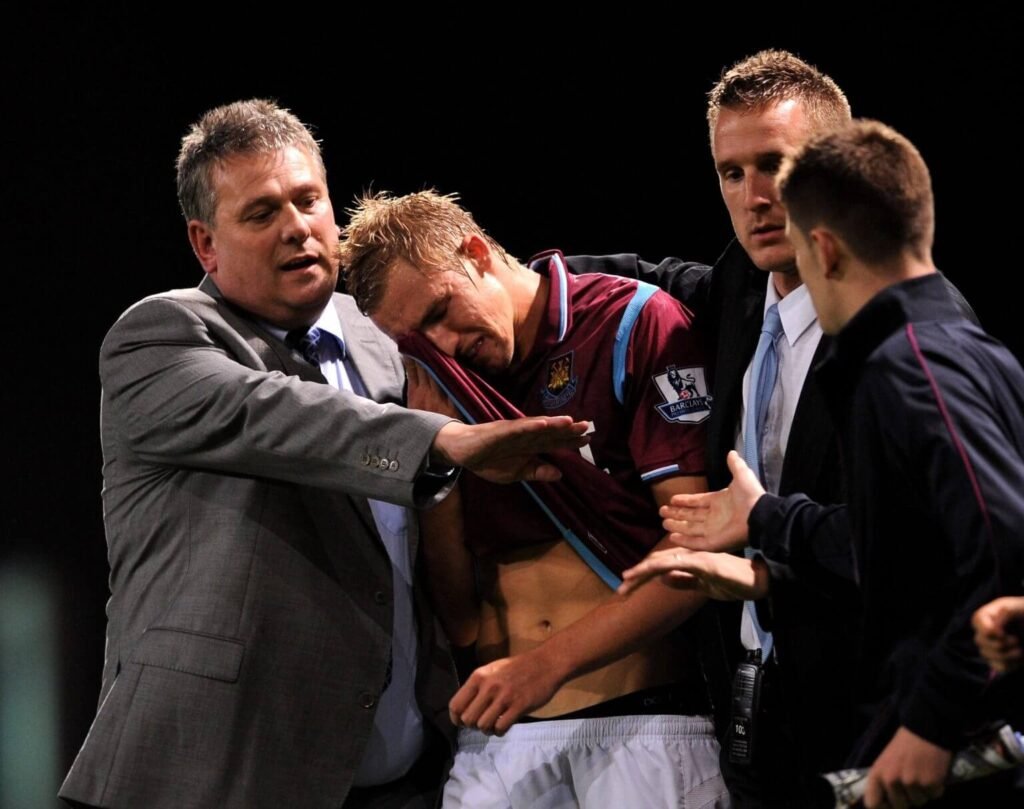
The build-up. Tension was rising before a ball had even been kicked. The Metropolitan Police cut Millwall’s away ticket allocation for the match from 3,000 down to 1,500, a decision that infuriated Millwall’s support and led the club to warn police there was now a heightened risk of trouble. Millwall had also travelled to Hull City in the FA Cup that January with a large contingent of supporters the club itself described as “high risk,” in a match overshadowed by missile-throwing after chants directed at ex-West Ham player Jimmy Bullard — a reminder that West Ham’s shadow followed Millwall’s away support into fixtures that had nothing to do with West Ham at all.
The Night Itself – 25 August 2009. Fighting broke out in the streets around Upton Park before kick-off. A 44-year-old Millwall supporter, out with his 17- and 18-year-old sons, was stabbed in the chest on Priory Road near the ground and suffered serious, non-life-threatening injuries. Missiles were thrown at police amid broader chaos that, by several accounts, caught bystanders and children in the crowd. In total, more than 20 people were injured around the ground that night, on top of the stabbing.
Inside the stadium, the match was repeatedly disrupted: home supporters invaded the pitch on three separate occasions, forcing the game to be temporarily suspended at one point. On the pitch, West Ham came from behind — Neil Harris had given Millwall an early lead — with two goals from Junior Stanislas either side of extra time and a third from Zavon Hines sealing a 3–1 win after extra time. It was West Ham’s first win over Millwall in seven meetings stretching back eighteen years. The World Cup Sculpture near Upton Park had been boarded up for protection before the game, on the assumption that trouble was likely.
The aftermath. The Metropolitan Police launched a dedicated investigation, Operation Balconi, to identify those involved. Police arrested roughly 85 people in connection with the disorder, the large majority of whom were charged, convicted, and given football banning orders of three years or more, with sentencing spread across Stratford Magistrates’ Court and Inner London Crown Court over the following months. Among the individual cases: Tom Massey, 22, pleaded guilty to a pitch invasion and received a three-year banning order and a £150 fine; Andrew Tatlow, in his early 40s, was convicted of violent disorder and sentenced in March 2010 to 20 months in prison plus a 10-year football banning order. By April 2010, West Ham confirmed the club itself had banned at least 54 individuals for life from the Boleyn Ground, including 11 season-ticket holders whose tickets were cancelled without refund, with a further ten supporters still awaiting court appearances.
The Football Association brought misconduct charges against both clubs. West Ham were found guilty on two counts — failing to prevent supporters entering the field of play, and failing to ensure fans refrained from violent, threatening, obscene and provocative behaviour — and were fined £115,000, an amount Millwall’s own club officials reportedly considered an insult given the scale of what had happened. Millwall faced three charges from the same incident and were cleared of all of them; a separate investigation into the stabbing did not result in charges. Police concluded that, given its scale and coordination, the violence had been organised in advance rather than spontaneous.
The disorder also had a political and reputational dimension that’s easy to forget now: with London bidding to host the 2018 World Cup, commentators and officials raised explicit concern that scenes like these could damage England’s case, and former West Ham manager Harry Redknapp said publicly that the football authorities should never draw the two clubs together in a cup competition again.
Not Just Violence
It’s worth saying plainly: the overwhelming majority of supporters on both sides have never been anywhere near any of this, and matches between the clubs are now planned around intelligence-led policing precisely because the risk, while real, involves a small minority. The fixture is still classed “Category C” by the Metropolitan Police — the highest risk rating in English football — but the last two league meetings, in 2011 and 2012, passed off without major incident under a coordinated, London-wide policing operation.
The rivalry has had its softer moments, too. In 2018, a Millwall supporter ran a sponsored half-marathon from The Den to the London Stadium wearing a West Ham shirt, to raise money for the medical treatment of Isla Caton, a young West Ham fan being treated for neuroblastoma. When Isla died in January 2022, both clubs set the rivalry aside to issue a joint statement of condolence to her family. Small as it is next to everything above, it’s a genuine data point too.
Why It’s Back This Season
West Ham’s relegation from the Premier League at the end of 2025–26 — alongside Burnley — dropped the Hammers into the Championship for the first time since 2011–12, and with it came an immediate reunion with Millwall. When the 2026–27 Championship fixture list was published in June 2026, the pairing was confirmed for the fixture’s 100th competitive meeting: Millwall host at The Den on 19 September 2026, with the return at London Stadium on 20 February 2027 — the first time Millwall will have played there at all.
The last time these two met, in February 2012, West Ham won 2–1 at Upton Park despite captain Kevin Nolan being sent off after nine minutes. Fourteen years on, with both clubs’ identities still tied to the docks and shipyards that produced them, and with a history this long and this dark behind them, it’s safe to assume this fixture will be marked on more calendars — and policed more heavily — than any other match on the Championship schedule this season.
Sources & Further Reading
This piece draws on contemporaneous news reporting, official club statements, and secondary historical sources. Where accounts of older incidents (particularly 1976 and 1978) differ in small details, we’ve noted the discrepancy rather than picked a version.
Primary Sources
- West Ham United F.C., “Millwall: an update” — official club statement on arrests, court cases and lifetime bans, 6 April 2010
- BBC Sport, “West Ham fined £115,000 over violence against Millwall”, 15 January 2010
- BBC News, “Mass violence mars London derby”, 25 August 2009
- BBC Sport, “FA to probe Upton Park violence”, 25 August 2009
- The Daily Telegraph (Chris Irvine), “Violence erupts at West Ham v Millwall match”, 25 August 2009
- The Daily Telegraph (Oliver Brown), “West Ham v Millwall: a history of how the rivalry started”, 28 August 2009
- The Independent (Chris Green), “A rivalry that dates back to the heyday of British shipbuilding”, 27 August 2009
- The Guardian (Owen Gibson), “West Ham and Millwall mount defence over Carling Cup violence”, 5 January 2010
Books
- Michael Calvin, Family: Life, Death and Football (2010) — embedded reporting on Millwall’s 2009–10 season, including the Upton Park riot and its build-up
- Cass Pennant, Congratulations You Have Just Met the ICF — West Ham’s Inter City Firm, from a former member
- Andrew Woods, No One Likes Us, We Don’t Care: True Stories from Millwall, Britain’s Most Notorious Football Hooligans
- Eric Dunning, Patrick Murphy & John Williams, The Roots of Football Hooliganism (1988) — academic study cited for the 1906 and 1978 incidents
- Ramón Spaaij, Understanding Football Hooliganism (2006) — academic source on the rivalry’s social history
Related on Premier Pulse