Origins: The Docklands, The Dockers & The Den
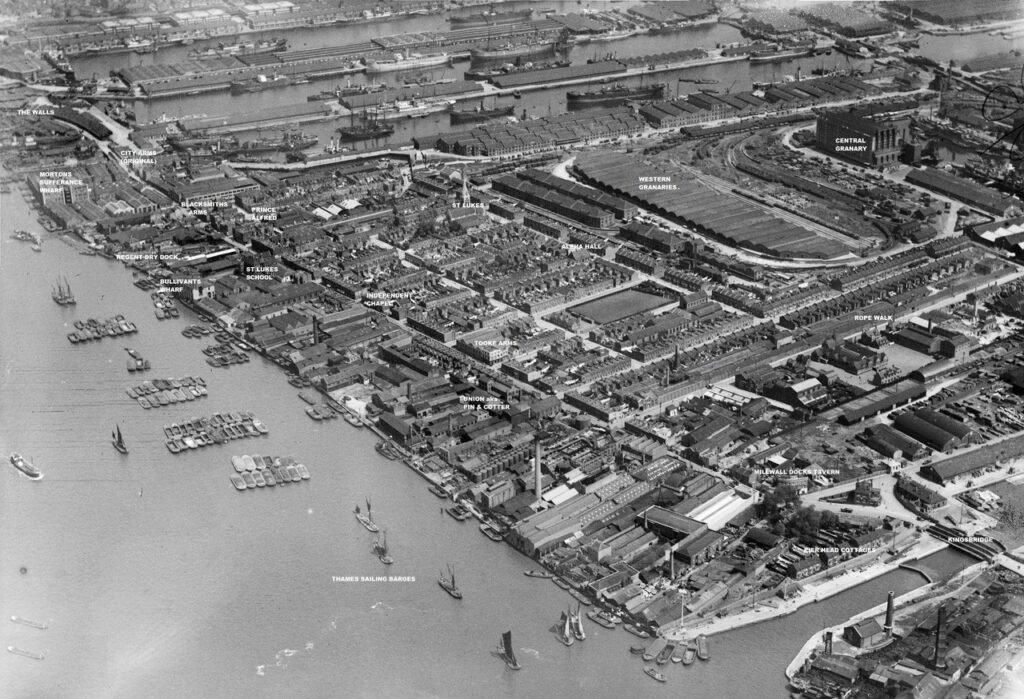
Millwall Football Club was not born in Bermondsey. It was not born south of the river at all. It began in 1885 on the Isle of Dogs, in the heart of East London’s industrial waterfront — and to understand everything that followed, you need to understand where it came from.
The club’s founders were not local Londoners. They were Scottish migrants, young blue-collar workers who had travelled south from Aberdeen to work at the John Thomas Morton & Sons canning and preserving plant on the Isle of Dogs. These were men shaped by hard labour — dockers, engineers, lightermen, labourers — the kind of trades that built things, moved things, and fixed things. When they weren’t working, they played football. And in 1885, they formalised that into Millwall Rovers. They even wore the blue and white of their homeland.
The Isle of Dogs in this era was far more than the warehouses and quaysides that people tend to picture. This was a major centre of British shipbuilding and heavy engineering. The Millwall Ironworks, one of the area’s defining industrial landmarks, produced the steel and armour plating that went into Royal Navy warships and military vessels. The men who founded this football club were the same men keeping Britain’s military and commercial fleet afloat. That context matters — because the physical toughness of the environment, the density of the community, and the pride of working men doing difficult, essential work all fed directly into the identity of the club they created.
The early years were nomadic. Between 1885 and 1910, Millwall moved between four different grounds on and around the Isle of Dogs — a restlessness that reflected the area’s practical limitations as much as anything else. The Isle of Dogs simply didn’t have the residential population to sustain a growing football club. Crowds need people, and people largely lived elsewhere.
That changed in 1910, when Millwall crossed the Thames and settled in New Cross, South East London. The Den — built at a cost of £10,000 and designed by the prominent football ground architect Archibald Leitch — became their permanent home. It was immediately distinctive. The closeness of the stands to the pitch, the noise that the ground seemed to trap and amplify, made it one of the most uncomfortable places in England to be a visiting player or supporter. That atmosphere didn’t happen by accident. It was an inheritance — the same working-class intensity that built the club on the Isle of Dogs now packed into a ground that had no intention of making anyone feel welcome.
By this point, the club had also begun to shed its original nickname. They had been known as the Dockers — a name that fitted them perfectly, rooted in the trades and the waterfront that gave birth to the club. But in the early years of the twentieth century, as British nationalism and imperial pride surged in the aftermath of the Boer War, the lion — the symbol of Britannia — increasingly became the club’s identity. The Dockers became the Lions. The badge changed. The working-class heritage did not.
What Millwall carried south of the river in 1910 was more than a football club. It was a community identity forged in a factory, hardened in the docklands, and shaped by men who had no particular interest in being liked by the rest of London. The siege mentality that would later define Millwall’s reputation — the defiance, the insularity, the pride in being set apart — was not manufactured in the terraces. It was there from the beginning, built into the foundations of the club itself.
[1]
60’s, 70’s, & 80’s: The Peak Years of Football Violence
The identity Millwall carried south of the river in 1910 was hardened by decades of industrial working-class life. But it was the decades that followed — specifically the 1960s, 70s, and 80s — that would transform that identity into something that made the whole country take notice, and not for reasons the club could be proud of. What happened at Millwall during this period did not happen in isolation. It happened inside a national epidemic – the football hooliganism epidemic.
The English Disease: Football Hooliganism and the Making of a National Crisis
To understand what Millwall became in the eyes of English football, you first need to understand the environment that produced them. The violence that defined Millwall’s reputation in the 1970s and 80s did not emerge from nowhere — it rose from a national epidemic that infected the sport from top to bottom, and Millwall were not its only carriers. They were simply its most recognisable face.
The Early Warning Signs: Hooliganism Before It Had a Name
Crowd trouble at English football matches is not a modern phenomenon. Incidents of disorder and fan violence stretch back to the earliest years of the professional game in the late nineteenth century, but for much of football’s early history it remained sporadic and largely contained. The Second World War and its aftermath brought a period of relative calm to the terraces — the shared national trauma and the social cohesion of the post-war years temporarily suppressed the tribalism that football had always harboured.
That calm did not last.
By the early 1960s, the mood had shifted. Reported incidents of serious football-related violence roughly doubled in just seven years — from an average of 13 incidents per season in the period up to 1960, to approximately 25 per season between 1961 and 1968. [2] Those numbers may seem modest by later standards, but the direction of travel was clear and the velocity alarming. Journalism and news outlets began using the phrase “football hooliganism” with increasing frequency across this period, giving the phenomenon a name and — whether intentionally or not — a platform. [3] Media coverage brought the problem to a national audience, and in doing so, helped cement it as a recognised feature of English football culture.
The violence itself was changing in character too. What had once been spontaneous, disorganised disorder on the terraces was beginning to take on structure and intent.
The 1960s: Organisation, Territory, and the Birth of the Firm
The late 1960s marked the decisive shift from random crowd disturbances to something altogether more deliberate. Young men — predominantly working class, predominantly drawn together by geographic identity and a shared sense of belonging — began forming organised supporter groups that would come to be known as firms. These were not simply groups of friends who sometimes got into trouble. They were structured outfits with hierarchies, territorial claims, and a shared purpose that went well beyond watching football.
Firms began staking out their sections of the terraces — the standing areas behind the goals, the ends — as their own. Rival firms challenged those claims. The confrontations that followed were increasingly premeditated rather than impulsive. This was a fundamental change: violence was no longer simply breaking out at football. It was being planned for, travelled to, and executed with intent.
The sociological explanation for why this moment happened when it did points to the post-war baby boom generation coming of age in an era of rapid cultural change, declining industrial employment, and a fractured sense of community in working-class Britain. Football provided the arena. The terrace provided the stage. And for thousands of young men with little else to organise their lives around, the firm provided the brotherhood.
The 1970s: Escalation and the Rise of the Fighting Crews
By the late 1970s, weekly disturbances among fan groups had become a near-routine feature of the English football weekend. The terraces were hostile environments. Away travel — on Football Special trains chartered to carry supporters to distant grounds — had become a battleground in its own right. Carriages were vandalised, rival fans ambushed at stations, and entire towns braced for the arrival of opposing supporters in a way that seems almost unimaginable from the vantage point of the modern game. [3]
The mid-70s brought a further evolution: the emergence of what observers began calling the fighting crews — more organised, more violent, and more strategically minded than the terrace gangs of the previous decade. These groups attached themselves to clubs the length of the country. Manchester United’s 1974 relegation from the First Division, for example, triggered scenes outside Old Trafford that shocked the nation — fans rioting in the streets, overturning cars, clashing with police. It was one of many signals that the problem had moved well beyond the stadiums.
Millwall — already carrying a reputation for fierce and hostile support from the previous decade — were about to become the defining symbol of this era.
F-Troop: Millwall’s First Firm
At their height in the mid-1970s, Millwall’s organised hooligan group was known as F-Troop, and they were unlike anything English football had seen. In the winter of 1975, the BBC current affairs programme Panorama ran an in-depth profile of the firm — giving the wider British public its first detailed look at what was happening behind the terraces at The Den. [4]
It would not be the last time the media and Millwall’s hooligan element would become intertwined.
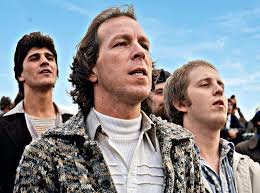
What made F-Troop genuinely distinctive was not just their capacity for violence but their organisation. The firm operated with a structured hierarchy that was almost military in its logic. At the youngest and least experienced level were the Underfives — placed deliberately alongside rival supporters, their role was to antagonise and provoke. They were the spark. Once a confrontation ignited, the next tier — known as the Treatment — would move in to take control of the fight. If the situation escalated beyond what the Treatment could manage, the final group would be deployed: the Surgery. These were the firm’s most hardened members, mostly men in their 30s and 40s, many carrying prior criminal records for violence. Their job was to finish things. The surgical masks that members wore became their most recognisable trademark — a deliberate, sinister piece of theatre that added to the group’s mystique and intimidation. [4]
F-Troop occupied the area behind the goal at The Den, and away games involving Millwall were understood across English football to be genuinely dangerous occasions. The firm’s reputation was built not just on what they did at The Den but on what they brought to other grounds across the country — an organised, disciplined group of men who had come specifically to fight.
F-Troop began to disband in the late 1970s. Key members were jailed, policing inside stadiums tightened, and the structural conditions that had allowed terrace violence to flourish were increasingly challenged by stadium managers and local police. The firm faded. But the culture it had seeded — and the reputation it had built — endured. From its remnants, something more organised, and in many ways more dangerous, would eventually take shape: the Bushwackers. But that comes later.
The 1980s: A National Crisis Reaches Boiling Point
If the 1970s were the incubation period, the 1980s were the eruption. The decade brought with it an extraordinary concentration of incidents that forced hooliganism from the back pages to the front, from sports coverage to parliamentary debate, and from a recognised social problem to a full-blown national emergency.
The broader context mattered enormously. Margaret Thatcher’s government identified football hooligans — alongside the IRA and striking miners — as one of the three great threats to public order in Britain. Industrial decline had gutted working-class communities across the north and midlands. Unemployment was rising. Social tension was everywhere. Football stadiums — crumbling, under-policed, and dangerously overcrowded — were the pressure valve. [2]
Government statistics on football-related arrests, systematically tracked from the 1984–85 season onwards, confirmed what anyone attending matches already knew: incidents were rising, arrests were increasing, and the authorities were losing control of the situation. [5]
The Day English Football Could Not Look Away: Millwall vs Luton, 1985
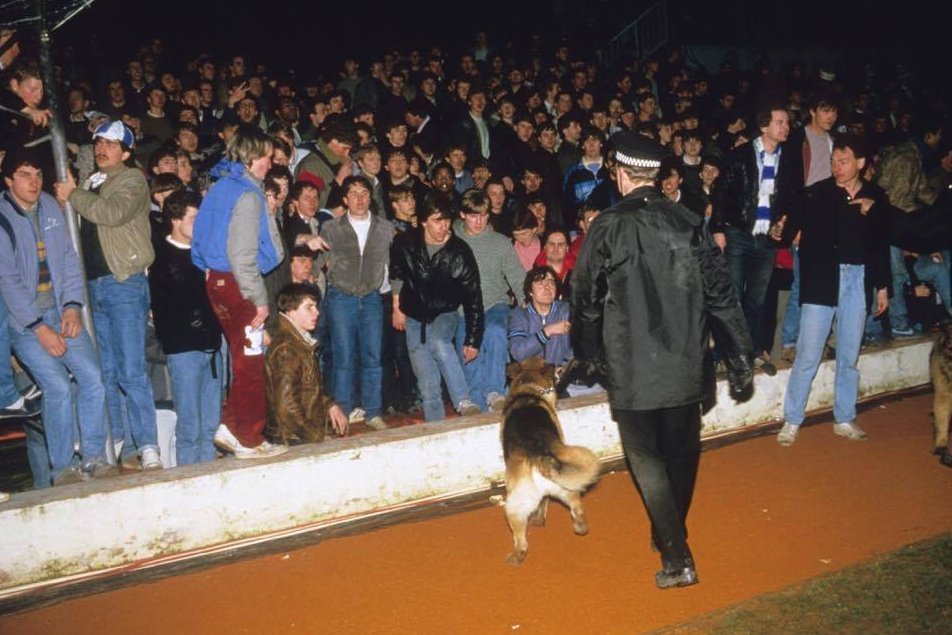
No single event did more to force the crisis into the national consciousness than the FA Cup fifth-round tie between Luton Town and Millwall at Kenilworth Road on 13 March 1985.
What happened that evening was not a brawl or a disorder. It was a riot — live, on national television, in front of the entire country.
Approximately 1,000 Millwall supporters breached the fences and gates installed to separate the fans and stormed into the Luton end, attacking home supporters with their fists, with projectiles, and with improvised weapons. Police were overwhelmed. The match was suspended after just 14 minutes of play. After a 25-minute halt, the game was eventually resumed — but by that point, what had happened off the pitch had already become the only story that mattered. The final toll: 47 people hospitalised, 31 arrested, and a fine of £20,000 levied against Luton Town — a peculiar and widely criticised decision given where the violence had originated. Parliament took up the matter directly, with debates igniting surrounding identity checks for supporters attending matches and potential travel bans for repeat offenders. [6]
The footage aired on national news bulletins across the country. Parliament took up the matter. Home Secretary Leon Brittan announced that the government would consider identity card schemes for supporters and potential travel bans for repeat offenders. In the 44 years of televised football in England up to that point, nobody had seen anything quite like it. The Kenilworth Road riot became the defining image of English football’s crisis — and Millwall were at the centre of it.
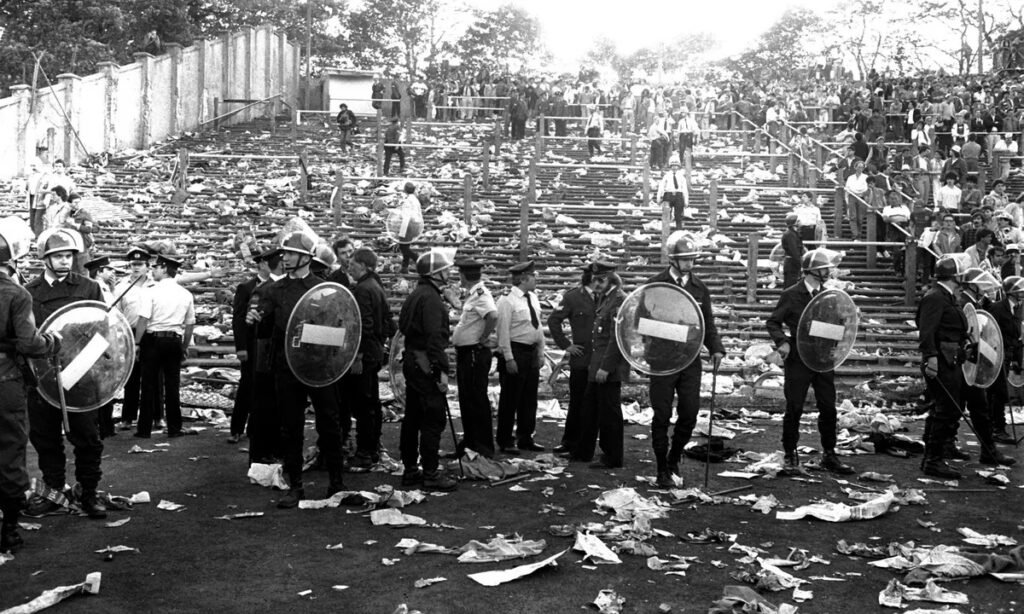
1985 was not finished. Just two and a half months later, on 29 May, Liverpool supporters rushed Juventus fans at the Heysel Stadium in Brussels ahead of the European Cup Final. A wall collapsed under the pressure of the crowd. Thirty-nine people were killed. UEFA imposed a five-year ban on all English clubs from European competition. English football had become a pariah on the continent.
And yet, as catastrophic as 1985 was, it was not the final reckoning. On 15 April 1989, 97 Liverpool supporters died in a crush at Hillsborough’s Leppings Lane terrace — the result of police decisions to open gates without adjusting containment, admitting over 10,000 people into a space designed for roughly half that number. Lord Justice Taylor’s subsequent inquiry was unequivocal: this was not caused by hooliganism. The disaster arose, he concluded, from a catastrophic failure of police control and stadium management — not fan behaviour. Taylor was equally pointed in his criticism of the media narratives that had rushed to blame “drunken and irresponsible supporters,” identifying those narratives as a deflection rooted in the era’s deep prejudices against working-class football fans. [7]
Taylor’s report would reshape English football entirely. The recommendations — mandatory all-seater stadiums for top-division clubs, the removal of perimeter fencing, and independent safety audits — were a direct response to a decade that had made the terraces among the most dangerous places in the country to spend a Saturday afternoon. [7]
For Millwall, and for the Bushwackers who had by this point replaced F-Troop as the firm at the centre of the club’s hooligan reputation, the reckoning was still coming.
The Bushwackers: South London’s Most Feared Firm
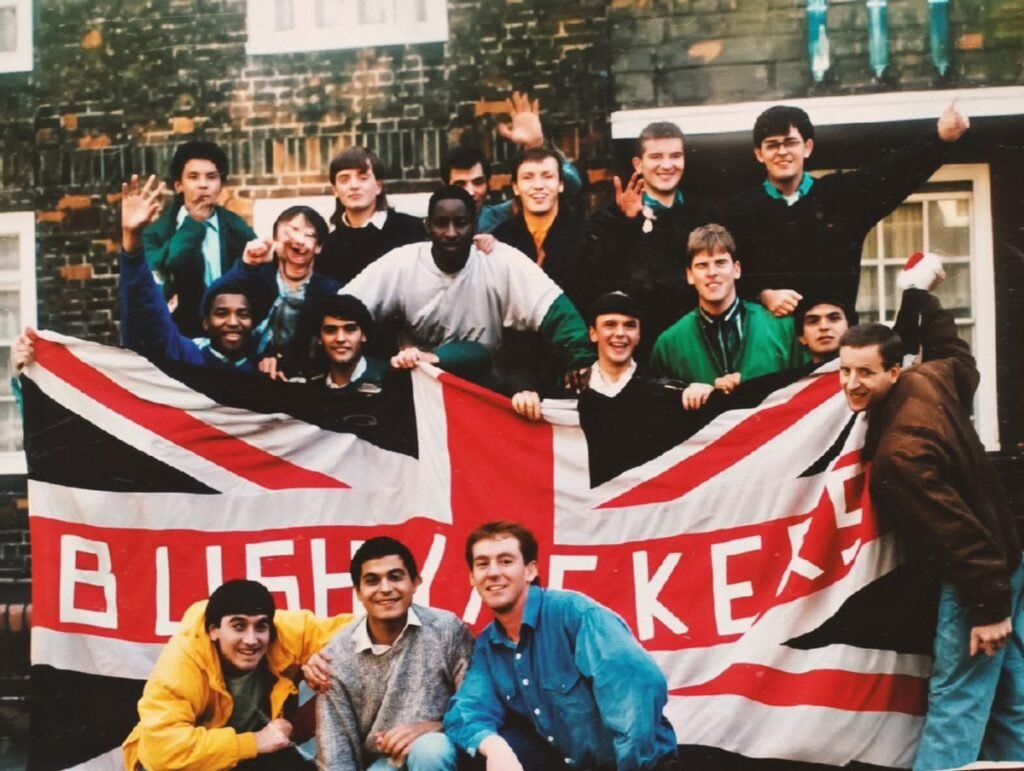
F-Troop had disbanded. Its key members were behind bars or had aged out of the terraces. But the culture they had planted in the soil of South London did not die with them. It mutated. By the late 1970s and into the early 1980s, a new entity had taken shape from the remnants of the old firm — one that would prove more organised, more durable, and ultimately more destructive than anything that had come before it. They called themselves the Bushwackers.
From F-Troop to the Bushwackers: The Evolution of a Firm
The transition from F-Troop to the Bushwackers was not a clean break. It was a gradual evolution, with the new firm drawing on the same geographic base — New Cross and its surrounding South East London communities — and the same recruitment pool of young working-class men shaped by an area of declining industry, rising unemployment, and a deep-rooted suspicion of the world beyond South London. [8]
What the Bushwackers brought that F-Troop had not fully developed was scale and reach. Where F-Troop had been principally a terrace outfit — fearsome at The Den, dangerous away, but fundamentally organised around the matchday experience — the Bushwackers extended their operations into the streets, the pubs, and the railway corridors of South London with a territorial ambition that went well beyond football. The areas they claimed stretched from New Cross and Deptford into Lewisham, Bermondsey, Peckham, and Southwark. These were not just areas where Millwall fans happened to live. They were territory — controlled, defended, and enforced. [9]
The firm also had a structure that mirrored, in some ways, the hierarchy of F-Troop before it. Younger members operated under the Bushwackers name, serving a kind of apprenticeship in the firm’s culture, before those who proved themselves could earn progression into the senior tier. It was, in its own grim way, an organised institution — one with its own code, its own hierarchy, and its own internal rules about who you fought and why.
The Away Day: Taking the Fight on the Road
What made the Bushwackers genuinely distinctive, and what separated them in the folklore of English football hooliganism, was not just what they did at The Den. It was what they were willing to do everywhere else.
Away days with Millwall during the late 1970s and 1980s were not sporting occasions in any conventional sense for the Bushwackers. They were expeditions — planned in advance, executed with purpose, and designed to impose Millwall’s reputation on whatever town or city was unfortunate enough to be hosting them that weekend. Police forces across England learned to treat a Millwall away fixture as a major public order operation. Towns that would barely register a Championship fixture between two other clubs braced themselves when Millwall were coming. The firm’s reputation for being both hard and entirely unpredictable made them uniquely difficult to police. [8]
The railway network was central to the away day culture. Football Special trains had been used for decades to ferry supporters to matches, but by the late 1970s they had become flashpoints in their own right — carriages vandalised, rival supporters ambushed at stations, platforms turned into battlegrounds. [4] For the Bushwackers, getting to an away ground was itself part of the occasion. The intimidation began long before kick-off.
One of the starkest illustrations of the Bushwackers’ willingness to operate well outside their own territory came in March 1976, when approximately 300 Millwall supporters travelled to Cardiff for a fixture against Cardiff City. They were outnumbered roughly seven to one — facing an estimated 2,000 rival hooligans. Rather than back down, the encounter descended into stabbings and widespread disorder, with a subsequent counter-attack involving 250 returning Millwall supporters that required significant police intervention to restore order. It was the kind of episode that, retold across football’s hooligan network, cemented a very specific kind of reputation — that Millwall’s firm did not calculate odds in the way that most people would. [10]
By 1982, the violence had reached such a pitch that Millwall’s own chairman, Alan Thorne, publicly threatened to close the club down entirely following a series of violent incidents that had brought the team into national disrepute. It was an extraordinary statement — a football club’s own leadership acknowledging that its fanbase had become an existential threat to the institution itself. [8]
The Battle of Highbury, 1988
Three years after Kenilworth Road had placed Millwall at the centre of English football’s crisis, the Bushwackers produced another episode that earned its own place in the grim catalogue of the era.
In January 1988, Millwall made the short trip to Arsenal’s Highbury for an FA Cup third-round tie. On paper, a London derby in a prestigious cup competition. In practice, one of the worst afternoons of football-related disorder that the capital had seen in years.
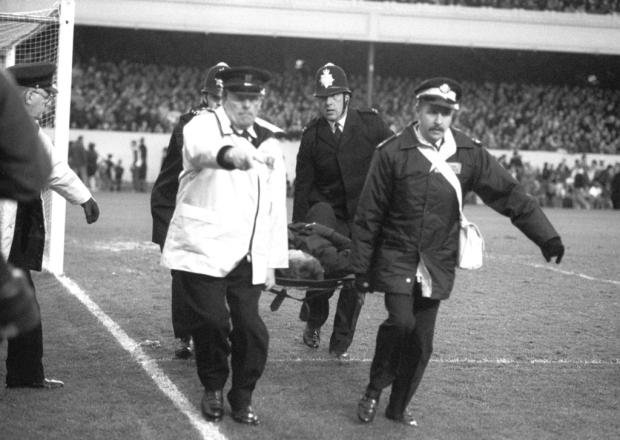
Five hundred specially trained police officers were deployed. They were not enough. Approximately 12,000 Millwall supporters packed into the Clock End, and a significant number of Bushwackers had deliberately infiltrated the home sections of the ground — a calculated tactic designed to spread the violence across the stadium rather than contain it to one end. When they made themselves known, the result was, in the words of one eyewitness who was a teenager in the home end that day, simply “bonkers.” [11]
Millwall supporters in the North Bank roared the club’s name and attacked anyone within range. The Clock End erupted simultaneously. Windows along the route back to Finsbury Park were smashed. Forty-one Millwall hooligans, led by Bushwackers figure Adam Luxford, were arrested after clashing with Arsenal’s own firm, The Herd. Sixty people were ejected from the ground. An injured police officer was stretchered away before kick-off. [11]
The Battle of Highbury illustrated precisely what made the Bushwackers different from a disorganised mob. The infiltration of home sections was premeditated. The coordination between supporters inside different parts of the ground was deliberate. This was not spontaneous disorder. It was planned, executed, and achieved exactly what it set out to achieve — chaos, fear, and another chapter in the Millwall myth that the Bushwackers were actively writing. [8]
Inside the Firm: Operation Pegasus and the Undercover Years
By the late 1980s, the Metropolitan Police had concluded that conventional policing (uniformed officers, CCTV, segregation) was not enough to break the Bushwackers. The firm was too organised, too embedded in the community, and too experienced at evading or absorbing standard police tactics. What was needed was intelligence from inside.
In 1987, a 21-year-old Metropolitan Police officer named James Bannon was given an assignment that most officers would have declined. Under Operation Pegasus, Bannon was tasked with infiltrating the Bushwackers — embedding himself within the firm for long enough to identify key figures and build an evidential case that conventional policing had been unable to construct. He went in posing as Jim Ford, a painter and decorator from Wandsworth, South London. [12]
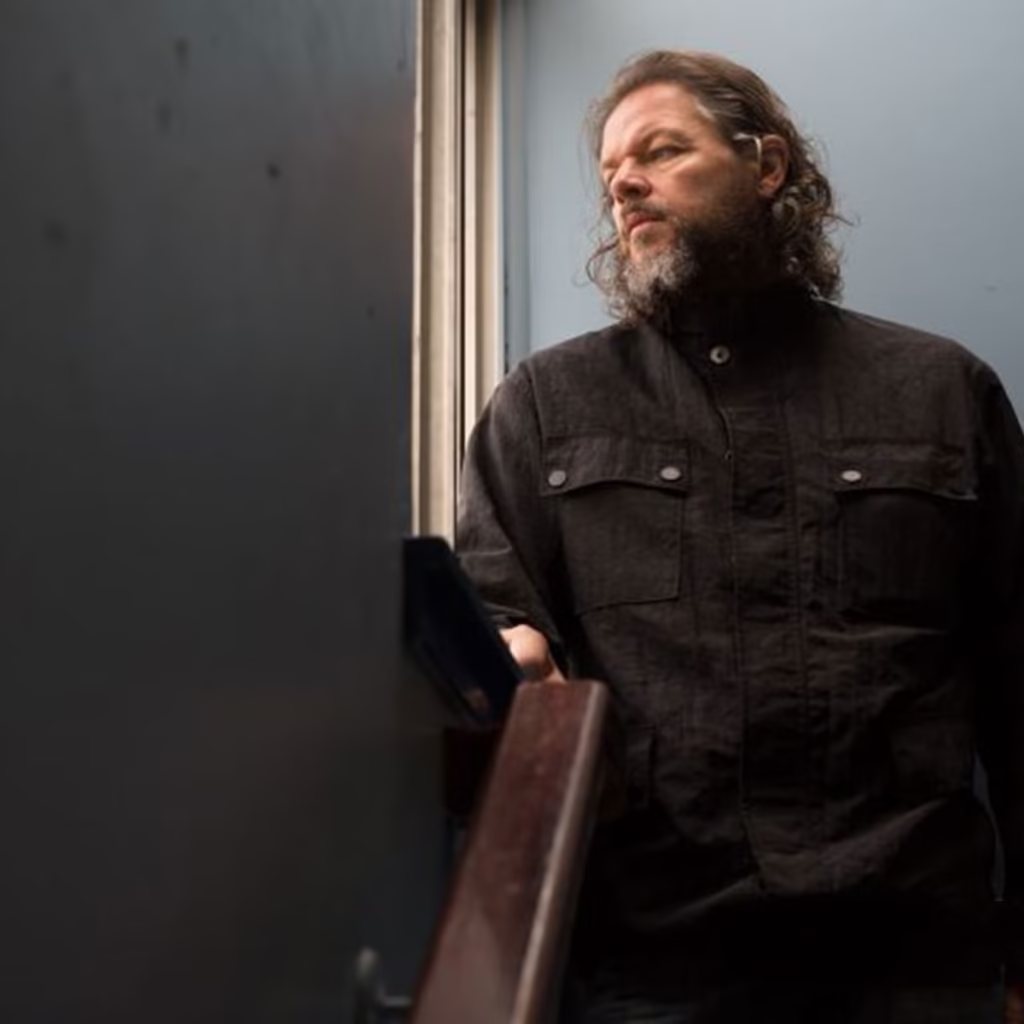
What Bannon encountered over the following two years — from 1987 to 1989 — was documented in his 2013 memoir Running with the Firm, and later formed the basis of the 1995 cult film I.D. The account is not a sanitised one. To earn the trust of senior Bushwackers members, Bannon had to participate in planned violence in pubs and backstreets. He described sitting alongside firm members as innocent fans were attacked — unable to intervene without blowing his cover. The moral weight of those decisions never fully left him. [13]
What Bannon’s account reveals, more than anything else, is the texture of the Bushwackers as a social institution rather than simply a violent gang. He described laughing more than he had ever laughed, meeting people he could imagine as lifetime friends in different circumstances — before catching himself and remembering why he was there. The firm provided something real to its members: community, identity, brotherhood, and purpose in an area of South London that, by the late 1980s, had seen its industrial base stripped away and its young men left with very little else to organise their lives around. [12]
That human texture does not excuse what the Bushwackers did. But it does explain why organisations like this proved so resistant to conventional law enforcement — and why simply arresting individuals was never going to be enough to dismantle what was, in its own deeply destructive way, a community institution.
The Media’s Role: How Coverage Made Everything Worse
Before examining what the media reported about Millwall Football Club, it is worth establishing something that most accounts of this era fail to acknowledge: the media in this story is not a passive bystander recording events from a distance. It is a character — active, consequential, and in many respects culpable. The coverage of Millwall’s hooligan problem did not simply reflect a crisis. It deepened it, amplified it, and in the most damaging cases, actively manufactured the identity that the club and its supporters have spent decades unable to escape. To understand how Millwall became synonymous with football violence in the British public consciousness, you must understand not just what happened on the terraces — but what happened in television studios and tabloid newsrooms.
Panorama, 1977: The Documentary That Defined a Club
On 14 November 1977, the BBC’s flagship current affairs programme Panorama broadcast an episode titled “F Troop, Treatment and the Half-Way Line.” [14] It was not the first time Millwall had attracted media attention. But it was the moment that fixed the club’s image in the national imagination — and it did so in ways that were far from accidental.
The documentary opens with Billy Plummer — a 21-year-old Millwall fan who has already accumulated legal trouble directly connected to his involvement in the club’s hooligan scene. Sitting alongside him is his eight-year-old younger brother, who is already attending home matches at The Den. The framing is immediate and deliberate: this is a lifestyle you are born into, passed from generation to generation, inescapable by design. Before a single piece of analysis has been offered, the viewer is being told a story — and that story has already decided its characters.
The documentary’s central thesis is delivered early and without ambiguity. “Millwall is more than a football club,” the narration states. “It is a way of life. The glory comes not from the team, but from the reputation of its supporters.” It is a striking line — and a revealing one. In a single sentence, the programme reduces an entire football club and its community to the violence of a minority, framing notoriety as the defining and only meaningful product of Millwall fandom.
What follows is a series of interviews with F-Troop members — the firm whose structure and hierarchy had already made them the most discussed hooligan outfit in England. The interviewees, it should be noted, were more than willing participants. They bragged openly about their involvement in violence, about fights with rival supporters, about the reputation they had built and the pride they took in it. Billy Plummer, speaking directly to camera, made clear that he was proud that Millwall supporters would always be known as hard — as the kind of people you did not mess with. When pressed on whether fines might serve as a deterrent for young men considering joining the hooligan scene, his answer was blunt: they would not. Fines were not a deterrent. They were, if anything, a badge of honour.
The documentary mapped the geography of The Den in detail — the specific stands and terraces where different supporter groups held territorial control, where the Underfives positioned themselves near rival fans, where the Treatment operated, where the Surgery waited. The effect was to present The Den as a military installation rather than a football ground, governed by hierarchy and violence rather than community and sport.
Panorama also touched, briefly, on the social context that had produced these young men. Billy Plummer, it emerged, had dropped out of school at thirteen. His home life had been shaped by an abusive father figure. The documentary gestured toward the economic and social conditions of South East London without ever seriously engaging with them — presenting them as backdrop rather than explanation, colour rather than cause. The harder, more uncomfortable questions about what post-industrial South London had done to the men who lived there were not asked.
The programme’s most revealing moment, arguably, had nothing to do with hooliganism at all. Millwall manager Gordon Jago appeared in the documentary, discussing his approach to the problem. Jago was one of the more progressive voices at the club — a man who held open days for supporters, who tried to engage with fans rather than dismiss them, and who was attempting to get the most violent members banned from the ground in order to make The Den feel safe enough for visiting supporters to attend in numbers. He understood, practically and financially, that the violence was destroying the club’s ability to sell tickets and grow. His message was measured and forward-thinking. The response from the supporters he faced was not. There was no appetite for change. The cult-like mentality of the terrace had too tight a grip. And complicating Jago’s efforts further, the National Front had begun actively recruiting within Millwall’s hooligan networks during this period — members who, having joined, would turn up specifically to get into fights, using Millwall fixtures as a convenient backdrop for political violence that had nothing to do with football.
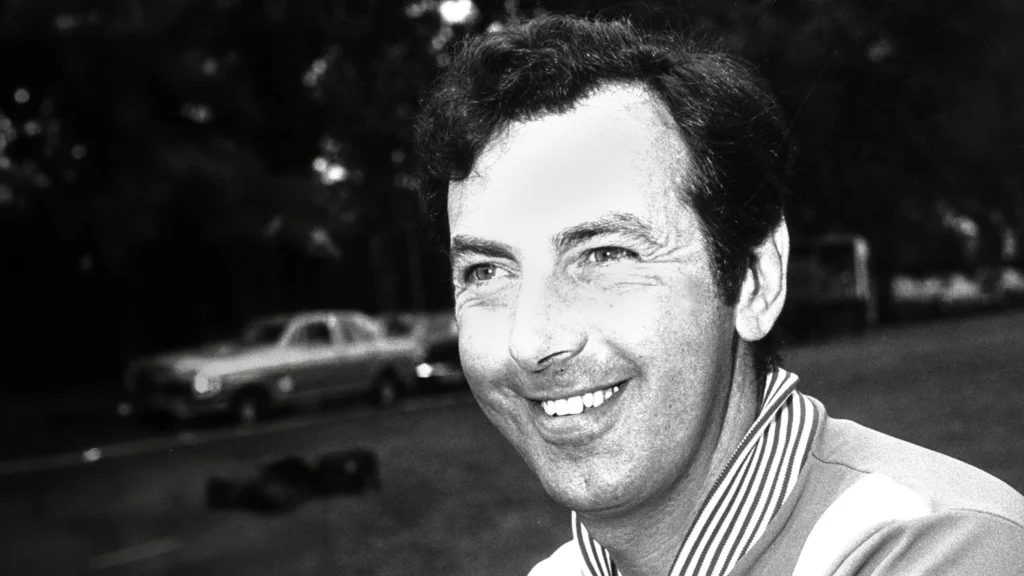
And yet, for all its apparent seriousness, the documentary’s treatment of the Millwall community never fully shed its condescension. At one point, the narration describes Millwall as “a friendly, hospitable club in its own working-class, cockney way” — a line so loaded with class assumption that it speaks volumes about the distance between the programme’s makers and the community they were purporting to understand. The interviewees, meanwhile, were asked about their futures — about marriage, children, families. Several responded that they could not see themselves getting married, that their loyalty to Millwall and to their firm took precedence over any conventional domestic life. Panorama presented this as evidence of dysfunction. It did not occur to the filmmakers — or if it did, it did not make the edit — that what they were actually hearing was a community of men for whom the firm had replaced the traditional social structures that had been stripped away from South East London by decades of economic decline.The result was a documentary that arrived with its conclusion already written. As one filmmaker, reflecting on how on-screen portrayals of the club have evolved, put it directly: “Panorama had an agenda of an image it wanted to create — this hardened football hooligan, and it just went and found those people.” [15]
There were no second-generation immigrant Millwall fans in the documentary. No women. No community figures. No voices from the majority of supporters who attended matches without incident. What Panorama built was not a portrait of Millwall. It was a caricature — carefully cast, selectively edited, and broadcast to millions of people who had no other frame of reference. And once that image was in the public mind, it proved almost impossible to dislodge.
The Tabloid Machine: Sensation, Language, and the Amplification Spiral
The BBC had given Millwall’s hooligan reputation a national platform. The tabloid press ensured it never left one.
Throughout the 1970s and into the 1980s, Britain’s red-top newspapers covered football hooliganism with a consistent and revealing editorial strategy: maximum sensation, minimum context. The headlines tell their own story. “Smash These Thugs” ran in The Sun on 4 October 1976. “Cage the Animals” appeared in the Daily Mirror on 21 April that same year. “Birch ’em!” followed in the Mirror that August. “Thump and Be Thumped” ran in the Daily Express in November. [16] These were not reports. They were incitements — designed to generate outrage, sell papers, and position the tabloids as the voice of a decent public besieged by savage football fans.
The language escalated as the decade progressed. A 1985 piece in The Sun described the English football hooligan as “quite possibly the lowest, least sensitive form of life.” Hooligans were routinely referred to in print as “scum,” “savages,” “animals,” and “lunatics.” The effect of this language was not to discourage violence. It was to dehumanise an entire section of working-class football support — and, critically, to make Millwall the permanent symbol of that dehumanisation.
The academic framework that best explains what was happening during this period was developed by sociologist Stuart Hall, who identified what he called an “amplification spiral.” [17] The mechanism works as follows: media coverage of a social problem generates public moral panic; moral panic produces political pressure for tougher responses; tougher policing and harsher measures create more confrontational environments; those confrontations generate more incidents; those incidents generate more coverage. The cycle feeds itself, and at every turn, it grows. Applied to Millwall, the spiral is almost perfectly visible. Each wave of coverage — the Panorama documentary, the Kenilworth Road riot, the Battle of Highbury — produced a fresh round of tabloid outrage, which deepened the Millwall identity, which attracted more of the kind of men who were drawn to that identity, which produced more incidents to report.
The most striking evidence that media coverage was driving the problem rather than simply reporting it comes not from England but from continental Europe. In Austria and Germany during the mid-to-late 1980s, newspapers and broadcasters made a deliberate editorial decision to reduce their coverage of football hooliganism. They stopped giving firms the platform. They stopped running the dramatic photographs and the inflammatory headlines. And the number of incidents fell. [16]
The contrast with England could not have been more stark. Here, the tabloids continued to compete with each other for the most lurid coverage, the most damning headlines, the most spectacular photographs — and here, uniquely in Europe, the problem continued to grow through the decade.
A History of Violence: The Millwall Incident Timeline
The sections that precede this one have told the story of how Millwall’s hooligan culture was born, how it was organised, and how the media amplified it into something that took on a life of its own. What follows is the evidence — the incidents themselves, laid out in chronological order, that explain why Millwall’s name carries the weight it does. This is not a comprehensive list of every episode of disorder connected to the club. It is a record of the most significant moments — the ones that shaped public perception, changed football’s relationship with crowd control, and left marks that have never fully healed.
1976 — Cardiff City Away: Outnumbered and Unbowed
In March 1976, approximately 300 Millwall supporters made the journey to Cardiff for a league fixture. What awaited them was not a football crowd. The valleys, as locals had it, had emptied out for the occasion — an estimated 2,000 Cardiff supporters, many intent on violence, were waiting. Millwall were outnumbered roughly seven to one.
They did not back down. The day descended into widespread disorder. Stabbings were reported. A counter-attack involving 250 returning Millwall supporters required sustained police intervention to restore order. [10]
The Cardiff away day became one of the defining stories in Bushwackers mythology — the day that cemented the firm’s reputation not just for violence, but for a specific, almost irrational refusal to calculate odds. Other firms would retreat when outnumbered that severely. Millwall did not. That reputation, once established, made every future away fixture carry a different kind of dread for host towns and police forces across the country.
1977 — Panorama Airs, Gordon Jago Resigns
This entry belongs in any timeline of Millwall hooliganism not because of violence on the terraces, but because of what happened off them. The BBC’s Panorama documentary aired on 14 November 1977 — and its consequences were immediate and profound. Manager Gordon Jago, having seen a preview of the film and having reportedly begged the BBC not to broadcast it, resigned shortly after transmission. [18]
The documentary had shown National Front activists selling literature outside The Den. It had broadcast interviews with F-Troop members bragging about violence. For Jago — a man who had been working constructively with fans, holding open days, and attempting to bring the club’s most extreme element under control — it was the final blow. The media had undone months of careful work in a single broadcast. The hooligan problem did not decline after the spotlight. It intensified.
1978 — FA Cup Quarter-Final vs Ipswich Town: The Den Becomes a Battlefield
Just four months after the Panorama documentary had introduced Britain to F-Troop, the watching public received confirmation that what the BBC had shown them was not exaggerated.
On 11 March 1978, Millwall hosted Ipswich Town in the FA Cup sixth-round quarter-final at The Den. The violence began before kick-off. Ipswich supporters arriving by coach were ambushed — Millwall hooligans pelted the vehicles with bricks, rocks, and bottles as they approached the ground. Inside The Den, the atmosphere was immediately hostile. When Ipswich’s George Burley scored a thunderous 30-yard opener, the terrace disorder that had been building erupted. Millwall supporters spilled onto the pitch. The game was halted for 19 minutes. [18]
When play eventually resumed, it did so against a backdrop of continued chaos. Bottles, iron bars, knives, fists, boots, and concrete slabs were used as weapons in and around the ground. Ipswich won the match 6-1 — but the scoreline was the least significant thing that happened that afternoon. Dozens of people were injured, including Millwall’s own supporters caught up in the disorder.
The consequences for the club were severe. The FA closed The Den for two weeks and banned Millwall from hosting FA Cup matches for two years — an extraordinary sanction that underlined just how seriously the authorities viewed what had happened. It was also, in retrospect, the clearest possible signal that the Panorama documentary had not exaggerated the problem. If anything, it had understated it.
1985 — Kenilworth Road: The Riot That Stopped the Country
Already covered in detail previously, the events of 13 March 1985 at Luton Town’s Kenilworth Road require their place in any timeline of Millwall violence — because no other single incident did more damage to the club’s reputation, or to English football’s standing, than what happened that evening.
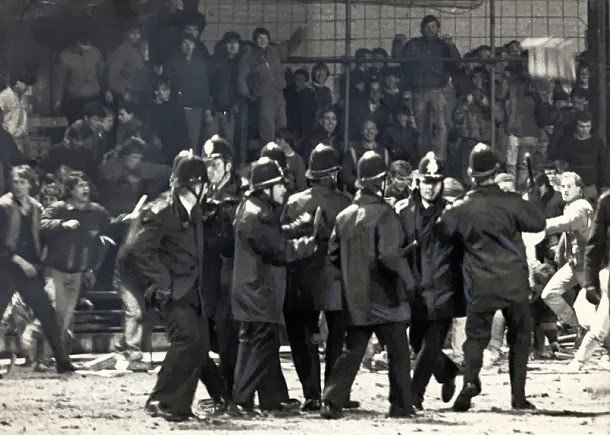
Approximately 1,000 Millwall supporters breached the fencing separating supporters, invaded the Luton end, and attacked home fans with fists, projectiles, and improvised weapons. The match was suspended 14 minutes in. Police were overwhelmed. Forty-seven people were hospitalised. Thirty-one arrests were made. The riot was broadcast live on national television. [6]
The consequences stretched well beyond Millwall. Luton Town imposed a complete ban on away supporters at Kenilworth Road that lasted four seasons. Parliament debated identity card schemes for football supporters. The images from Kenilworth Road were used in every subsequent political and media discussion about the state of English football — and Millwall’s name was attached to all of them. The club was fined £7,500 by the FA. The far more significant punishment was reputational, and it was permanent.
1988 — The Battle of Highbury
On 9 January 1988, Millwall travelled to Arsenal’s Highbury for an FA Cup third-round tie. Five hundred specially trained police officers were deployed. It was not enough.
Millwall supporters deliberately infiltrated Arsenal’s home sections — a premeditated tactic designed to spread disorder across multiple parts of the ground simultaneously. When the Bushwackers made themselves known inside the North Bank, fighting broke out across the stadium. Windows were smashed along the route back to Finsbury Park. Forty-one Millwall hooligans, led by Bushwackers figure Adam Luxford, were arrested following clashes with Arsenal’s firm The Herd. Sixty people were ejected from the ground. A police officer was stretchered away before kick-off. [11]
The Battle of Highbury, as it became known, stands apart from many Millwall incidents for one reason above all others: it was not spontaneous. The infiltration of home sections required planning. The simultaneous disorder in multiple parts of the ground required coordination. This was organised, deliberate, and executed with precision — which is precisely what made it so alarming to the football authorities and Metropolitan Police trying to contain it.
1990 — The Taylor Report: A New Era That Did Not Reach Everyone
The publication of Lord Justice Taylor’s report in 1990, and the subsequent mandate for all-seater stadiums across the top two divisions of English football, fundamentally changed the landscape of crowd disorder in England. Perimeter fencing — the cages that had defined the terrace experience and contributed directly to the Hillsborough disaster — came down. CCTV was expanded. Policing intelligence became more sophisticated. Across the country, the structural conditions that had allowed organised hooliganism to flourish inside stadiums were systematically dismantled.
For the majority of English clubs, the 1990s brought a genuine and sustained reduction in terrace violence. The Premier League era, launched in 1992, ushered in a wave of commercialisation, higher ticket prices, and a changing demographic in English football’s stadiums that pushed many of the old hooligan generation to the margins. [8]
For Millwall, the 1990s brought the same structural changes — but the same results did not fully follow.
1993 — Moving to The New Den: A Fresh Start That Wasn’t
In August 1993, Millwall relocated from the old Den at Cold Blow Lane to a new 20,000-seat all-seater stadium at Senegal Fields in Bermondsey — The New Den. It was presented, in part, as an opportunity for the club to shed some of the baggage of the old ground and signal a new chapter. The old Den had hosted some of the worst episodes in the club’s hooligan history. A modern stadium, with modern crowd management, was supposed to represent a break from that past.
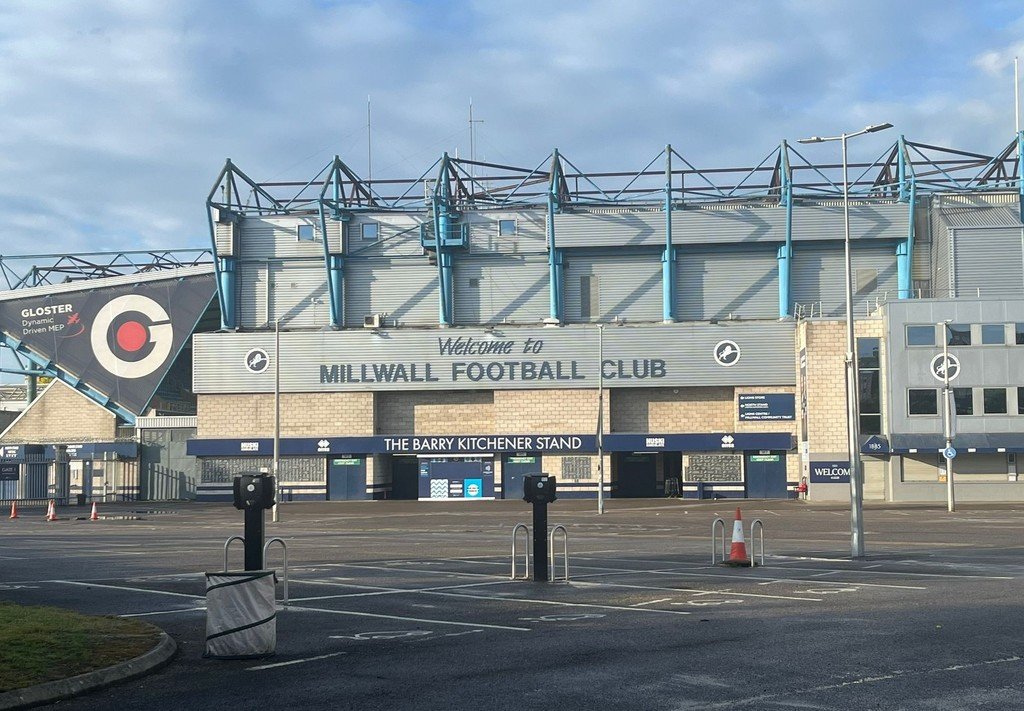
The first competitive season at The New Den ended with Millwall finishing third in the First Division — good enough to enter the play-offs for a place in the newly formed Premier League. Their opponents in the semi-final were Derby County.
1994 — Derby County Play-Off Semi-Final: The New Ground, The Same Problems
On 18 May 1994, Millwall hosted Derby County in the second leg of their First Division play-off semi-final at The New Den. Already trailing 2-0 from the first leg, and with their Premier League hopes slipping away, the match descended into one of the most chaotic and embarrassing evenings in the club’s history.
When Derby’s Marco Gabbiadini scored early in the second leg, and a second goal followed shortly after, Millwall supporters invaded the pitch in large numbers. Players scattered. Mounted police moved in. Numerous arrests were made. The game was halted for nearly 20 minutes before play could restart.
When the match resumed, Derby extended their lead further. Then, with the referee about to award Millwall a penalty in the second half — a moment that might have offered some hope of a comeback — a second pitch invasion took place. Players retreated to the dressing rooms again for 12 minutes. When they returned, the referee declined to award the penalty. Derby won 3-1 on the night, 5-1 on aggregate.
The images of players running for cover as Millwall supporters flooded the pitch at their brand new stadium — barely a year after it had opened — were broadcast nationally. The new ground had not produced a new identity. Millwall’s chairman Reg Burr, to his credit, did not attempt to deflect responsibility. He acknowledged the violence directly, but also made the pointed observation that the play-off system itself was a structure that placed clubs under extraordinary pressure at the most volatile moments of their season. [9]
It was a sobering reminder that the problems attached to Millwall’s most extreme supporters were not a product of an old ground with a particular atmosphere. They were deeper than that. A new stadium had not changed them. It would take more than bricks and mortar.
2001–02 Season — The “Mad Season”
If the Taylor Report and the all-seater era of the 1990s had suggested the worst was behind English football, the 2001–02 season at Millwall served as a brutal reminder that organised hooligan culture had not disappeared — it had merely gone quiet.
The season began on 4 August 2001, before a ball had even been kicked competitively, when Millwall hooligans clashed with Tottenham Hotspur supporters outside the Caulkers pub in Bermondsey. Dozens were injured. Among the casualties were 30 police officers, three police horses, and one man who required treatment for stab wounds. [9]
Seventeen days later, Millwall fans rioted in the streets surrounding The Den following a League Cup tie with Cardiff City — damaging buildings and vehicles and throwing missiles at police. On 31 October, a group of Millwall hooligans rampaged through Wolverhampton before a league fixture against Wolves, resulting in two Wolves supporters suffering facial stab wounds. On 13 December, approximately 100 Millwall and Portsmouth hooligans clashed at the Windmill public house near Waterloo station — every window smashed, all fixtures and fittings destroyed — with all participants escaping before police arrived.
The season’s defining incident came on 2 May 2002. Following Millwall’s Division One play-off semi-final exit — a 2-1 aggregate defeat to Birmingham City — approximately 900 supporters rioted in the streets surrounding The New Den for over an hour. Almost 100 police officers were injured, attacked with bricks, rocks, and fireworks. Two cars were torched. Buildings were damaged. Seven arrests were made — a number that experienced officers immediately recognised as woefully inadequate given the scale of what had happened. Sergeant Russell Lamb of the Metropolitan Police — a veteran of the May Day riots and the Poll Tax riots — described it as the worst violence he had ever witnessed in his career. [9]
2013 — FA Cup Semi-Final vs Wigan: Wembley, Broadcast Worldwide
Thirty years on from the peak years of Millwall hooliganism, the 2013 FA Cup semi-final at Wembley offered the watching world a reminder that the problem had not been solved — only managed.
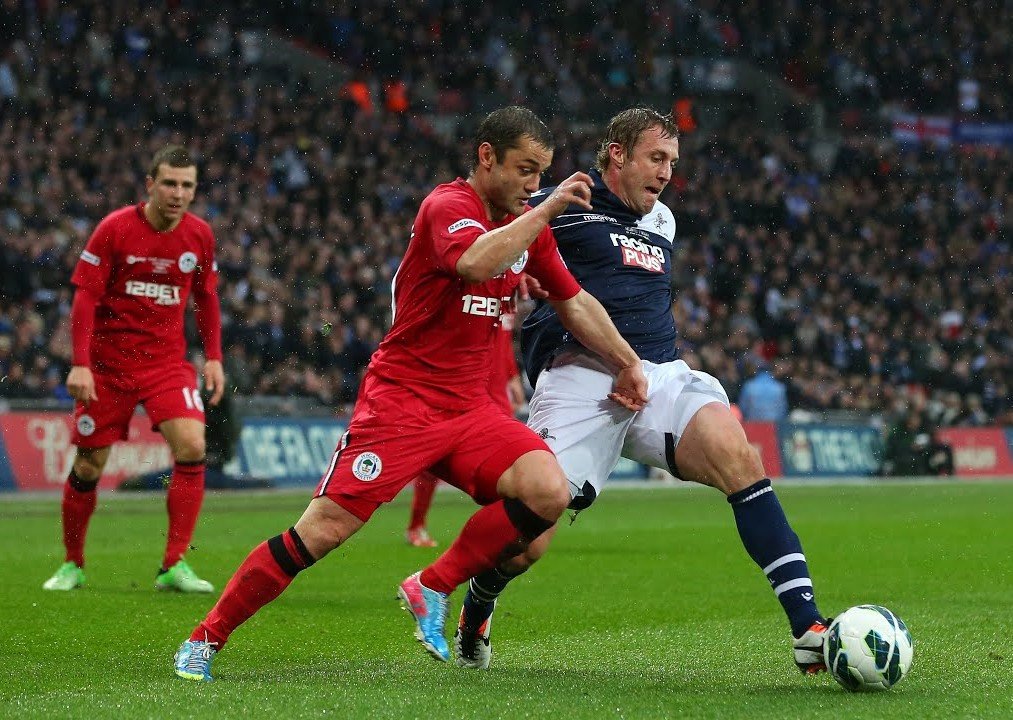
On 13 April 2013, with Wigan Athletic closing in on a 2-0 victory that would take them to the FA Cup final for the first time in their history, fighting broke out in the Millwall supporters’ end. It was not a clash between rival fans — it was Millwall supporters attacking each other. Groups traded punches as stewards and police struggled to intervene. A young female Wigan supporter was photographed in tears as violence raged around her. One fan stripped to the waist stood with blood streaming from facial wounds. Another was photographed smiling as he walked away with a stolen police hat. [19]
The scenes were broadcast to a global television audience — millions of people watching the FA Cup saw Millwall’s name attached to violence at English football’s national stadium. Fourteen arrests were made inside Wembley. A further six arrests followed outside the stadium and at a nearby tube station. The Football Association launched an immediate investigation.
2019 — Millwall vs Everton: The Problem Returns to the Streets
On 26 January 2019, Millwall hosted Everton in the FA Cup fourth round at The Den — a fixture that ended in a memorable 3-2 Millwall victory. Before kick-off, the narrative had already been taken out of football’s hands.
In the Hawkstone Road area of Southwark, close to The Den, a mass brawl erupted between what police believed to be groups of rival supporters. During the fighting, a man in his 20s was slashed across the face with a knife and hospitalised. Videos of the brawl circulated on social media and were viewed more than a million times within hours. [20]
Everton supporters were held inside the stadium after the final whistle on safety grounds. Detective Inspector Darren Young of the Metropolitan Police described the behaviour as “nothing short of disgraceful,” adding that the footage circulating online had “quite rightly elicited shock and disgust.” [21]
For the majority of Millwall supporters — those who had watched the match, celebrated the victory, and gone home peacefully — the events on Hawkstone Road were a familiar injustice. A minority had, once again, ensured that the result was the secondary story. The name Millwall, once again, was in headlines for the wrong reasons.
The Fall: Banning Orders, Intelligence, and the Dismantling of the Firms
By the late 1980s, English football’s authorities, the government, and the Metropolitan Police had arrived at a shared conclusion: conventional policing alone was not going to break the organised hooligan firms. Arresting individuals on matchdays produced low conviction rates, modest sentences, and no lasting structural damage to the groups themselves. The Bushwackers had survived a decade of uniformed policing, stadium segregation, and CCTV expansion without meaningfully diminishing. Something more systematic was needed — and what followed was a coordinated, multi-layered dismantling operation that took the better part of two decades to complete.
The Football Spectators Act 1989: Giving the Law Real Teeth
The legislative turning point came with the Football Spectators Act 1989, introduced in the immediate aftermath of the Hillsborough disaster and the broader crisis of the decade. For the first time, courts were given the power to issue Football Banning Orders — a mechanism that barred known troublemakers from attending matches for periods of up to ten years. Crucially, breach of a banning order was itself a criminal offence, creating a deterrent that previous legislation had entirely lacked. [22]
Prior to this legislation, the worst outcome a hooligan could realistically expect following an arrest at a football match was a modest fine. Firms had, in effect, priced violence into their activities — the financial penalty was manageable, the reputational reward within the firm was significant, and the risk of anything more serious was low. The 1989 Act changed that calculus. For the first time, being identified as a key figure in a hooligan firm carried genuine long-term consequences — not just for matchdays, but for the ability to participate in the culture at all.
Academic research into the effectiveness of banning orders identified two distinct mechanisms by which they worked to reduce disorder. The first was specific deterrence — targeting identified hardcore members and making clear to them personally that reoffending would result in certain and escalating punishment. The second was general deterrence — the visible punishment of known figures serving as a warning to the wider pool of potential recruits that the consequences of involvement had fundamentally changed. [23]
Operation Pegasus and the Intelligence War
Banning orders could punish. They could not, by themselves, identify who to target. That required intelligence — and the Metropolitan Police’s experience of trying to police Millwall fixtures from the outside had made clear that conventional surveillance was insufficient. The Bushwackers were too embedded in South London’s social fabric, too experienced at operating in plain sight, and too disciplined about avoiding identifiable behaviour when police were visibly present.
The answer was Operation Pegasus — the undercover infiltration of the Bushwackers by 21-year-old officer James Bannon beginning in 1987, already covered in detail in earlier. What Pegasus produced, beyond the immediate arrests and convictions it enabled, was a template. The operation demonstrated that intelligence gathered from inside a firm could be used to identify key figures, map networks, and build evidential cases that conventional policing was structurally incapable of constructing. Ahead of the 1990 World Cup in Italy, the Metropolitan Police extended similar undercover operations to firms connected to Arsenal, Chelsea, Manchester City, and Manchester United — a recognition that what had worked against the Bushwackers could be applied across English football’s hooligan landscape. [12]
The Taylor Reforms and the Structural Transformation of English Football
Running parallel to the legislative and intelligence offensive was the physical transformation of English football’s stadiums. The Taylor Report’s mandate for all-seater grounds, implemented progressively through the early 1990s, removed the structural conditions that had made terrace violence possible in the form it had taken for three decades. Standing terraces — where firms could mass together, move fluidly, and organise confrontations — were replaced by seated sections where every supporter was assigned a specific, identified location. Perimeter fencing came down. CCTV networks expanded dramatically. The geography of the matchday experience was fundamentally reorganised in ways that made the choreographed terrace violence of the Bushwackers era structurally impossible to replicate.
The cultural context shifted too. The commercialisation of English football following the launch of the Premier League in 1992 brought higher ticket prices, a changing supporter demographic, and a sustained effort by clubs to reposition the matchday experience as a family-friendly product. The old hooligan generation found themselves increasingly marginalised — not just by policing and legislation, but by a football economy that was actively replacing them with a different kind of fan.
Theo Paphitis and the Membership Scheme: The Club Fights Back
The structural and legislative changes at a national level were matched, at Millwall specifically, by a decisive intervention from within the club itself.
Following the catastrophic 2002 Birmingham City play-off riot — described by veteran Metropolitan Police officer Sergeant Russell Lamb as the worst violence he had ever witnessed in his entire career — Millwall chairman Theo Paphitis introduced a mandatory supporter membership scheme that fundamentally changed the mechanics of attending Millwall matches. [9]
Paphitis, who had taken the club out of administration in 1997 and guided it to its first ever FA Cup Final in 2004, understood that the hooligan reputation was not just a moral problem — it was an existential financial one. The scheme required supporters to register in advance for tickets to designated high-risk fixtures, creating a paper trail that made it possible to identify, ban, and prosecute individuals involved in disorder in ways that anonymous cash-at-the-turnstile matchday attendance had never permitted. Scotland Yard had threatened to sue Millwall following the 2002 riot. The Metropolitan Police eventually withdrew the threat, stating that the efforts made — including a donation to a charity supporting injured police officers — had demonstrated sufficient institutional commitment to addressing the problem.
The membership scheme was not universally popular with Millwall’s wider fanbase. Many supporters felt it disproportionately restricted peaceful fans and damaged the club’s away following at a moment when travelling support was already declining. At fixtures considered high-risk by West Yorkshire Police, for example, Millwall supporters were issued with vouchers to be exchanged for tickets at a designated police-controlled point on matchday — a logistical burden that deterred all but the most committed travellers. It was an imperfect tool. But it worked.
The Diminished Firm
The cumulative effect of banning orders, undercover intelligence, all-seater stadiums, the membership scheme, and sustained metropolitan policing attention was, over the course of the 1990s and 2000s, the structural erosion of the Bushwackers as an organised institution. The firm did not disappear — incidents in the 2000s and at Wembley in 2013 demonstrated that clearly — but its scale, organisation, and capacity for the kind of coordinated, premeditated disorder that had defined it at its peak in the 1980s were substantially reduced. [9]
What remained was a residue — a hardcore of individuals carrying the cultural identity of the firm without the organisational infrastructure that had once made it genuinely dangerous in a systematic way. The 2013 Wembley disorder, as shocking as it was to witness, was largely internal — Millwall supporters fighting each other — rather than the coordinated assault on rival fans and police that the Bushwackers of the 1980s had represented. The nature of the violence had changed. Its causes had not been entirely removed. But the organised firm, in the form that had made English football’s authorities genuinely frightened, had been broken.
Millwall Today — and What Comes Next
The Millwall Football Club that exists in 2026 is a complicated institution to summarise simply. It is a club that has worked genuinely hard to move beyond a reputation it did not entirely deserve and has never been entirely able to escape. The Millwall Community Trust — one of the most active and well-regarded community outreach operations in the EFL — runs programmes across South East London covering education, health, disability sport, and youth engagement. The club has invested seriously in anti-discrimination work and in building a matchday environment that is accessible and welcoming to supporters of all backgrounds.
The majority of the people who fill The Den on a Saturday afternoon are ordinary football supporters — passionate, loyal, deeply connected to a club and a community that has been defined for too long by its worst moments and its least representative people. The story this article has told is real. But it is not the whole story of Millwall, and it has never been.
The hooligan culture that F-Troop and the Bushwackers built has not fully disappeared. Isolated incidents — some covered in this article — have continued to surface across the 2000s, 2010s, and into the current decade. The name Millwall still triggers a specific reaction in people who have never attended a match at The Den. The myth, as Garry Robson identified a quarter of a century ago, has become durable enough to sustain itself largely independently of the reality beneath it.
What is undeniable is that English football has changed, and Millwall has changed within it. The structural conditions that produced the epidemic chronicled in these pages — crumbling all-standing stadiums, anonymous attendance, minimal policing intelligence, a media ecosystem that rewarded sensationalism over accuracy — have been fundamentally altered. The Bushwackers at their 1980s peak could not exist in the matchday environment of 2026. That is not nothing. That is, in fact, most of the story of how English football pulled back from the abyss.
And the story is about to gain a new chapter.
West Ham United were relegated from the Premier League at the end of the 2025-26 season, joining Millwall in the EFL Championship for the 2026-27 campaign.
For the first time in over a decade, these two clubs will share a division — and they will meet twice in the league before the season is out.
For supporters of both clubs, the prospect of a Millwall vs West Ham derby — in the Championship, with real stakes, at grounds where the atmosphere will be unlike anything else in English football — is the most anticipated fixture of the coming season. For football authorities and Metropolitan Police planners, it represents one of the most significant crowd management challenges in years.
The history you have read in this article will be present in the stands on both matchdays. Whether it stays there is another question entirely.
References:
- Isle of Dogs – Past Life, Past Lives
- Sports History Weekly – Hillsborough Disaster
- Politics – Football Hooliganism
- The Sport Journal – Menaces to Management: A Developmental View of British Soccer Hooligans, 1961-1986
- Gov UK Statistics – Football-related arrests statistics, England and Wales, 1984 to 1985 season to 1999 to 2000 season
- The Guardian – Luton Town v Millwall 1985 – the night football died a slow death
- BBC News – The time when football fans were hated
- Middlesex University – Football hooliganism, the death drive and Millwall fandom
- The Firms – Millwall Bushwackers
- Hooligan FC – Millwall Hooligans: Then and Now
- Islington Gazette – Arsenal v Millwall in 1988: The ‘bonkers’ afternoon when violent fans terrorised Highbury
- Sport Bible – Policeman Undercover in Football Hooligan Firm ‘Snapped’ in Terrifying Incident
- Transpontine – Undercover with the Bushwackers
- IMDB – F-Troop, Treatment, and the Half-Way Line
- London Football Scene – How Millwall on the Screen Documentary Challenges What it Means to Support the Club
- Social Issues Research Centre — Football Violence in Europe: Media Coverage
- Marked by Teachers — Football Hooliganism: A Moral Panic Fuelled by Media Amplification
- East Anglian Daily Times — Violence Erupts at The Den
- BBC Sport — Millwall-Wigan FA Cup Semi
- BBC News — Millwall v Everton: Man Slashed in Face
- Associated Press via Sports Illustrated – Violence and FA Cup upsets: Millwall lives up to reputation
- Jamie M. Greer — Medium: The Rise and Supposed Fall of English Hooliganism
- University of Stirling — Football Banning Orders
- Middlesex University Academic Journal