Relegation from the Premier League is one of the most financially devastating events in English football. The moment a club drops into the Championship, the broadcast millions that sustain Premier League squads disappear almost overnight – and without a safety net, the consequences can be catastrophic. That safety net is the parachute payment, and understanding how it works goes to the heart of why English football’s financial landscape looks the way it does today.
In this guide, we explain exactly what Premier League parachute payments are, how they are calculated, how much relegated clubs actually receive, and why the system has become one of the most debated topics in the modern game. Whether you’re trying to understand why certain clubs bounce straight back up to the Premier League, why the Championship feels increasingly unequal, or what English football’s new independent regulator plans to do about it – this is everything you need to know about parachute payments.
What Are Premier League Parachute Payments?
The principle is straightforward enough. When a club drops out of the Premier League, it continues to receive a share of the top flight’s broadcast revenue for up to three seasons afterwards. The idea is to give clubs time to adjust, to wind down inflated wage bills, restructure contracts, and rebuild on a budget more suited to life in the Championship, without being forced into crisis mode overnight.
The system was introduced in 2006, initially covering just two seasons. Over the years it has evolved considerably, with the current structure – spread across three years and tied directly to a percentage of Premier League broadcast income – coming into effect for clubs relegated from the 2015/16 season onwards.
England is the only country in the world with a system like this. That’s no coincidence. The Premier League’s broadcasting revenue is so astronomically large compared to any other division, or indeed most other leagues globally, that without some form of financial bridge, the drop would be existential for many clubs.
How Do Parachute Payments Actually Work?
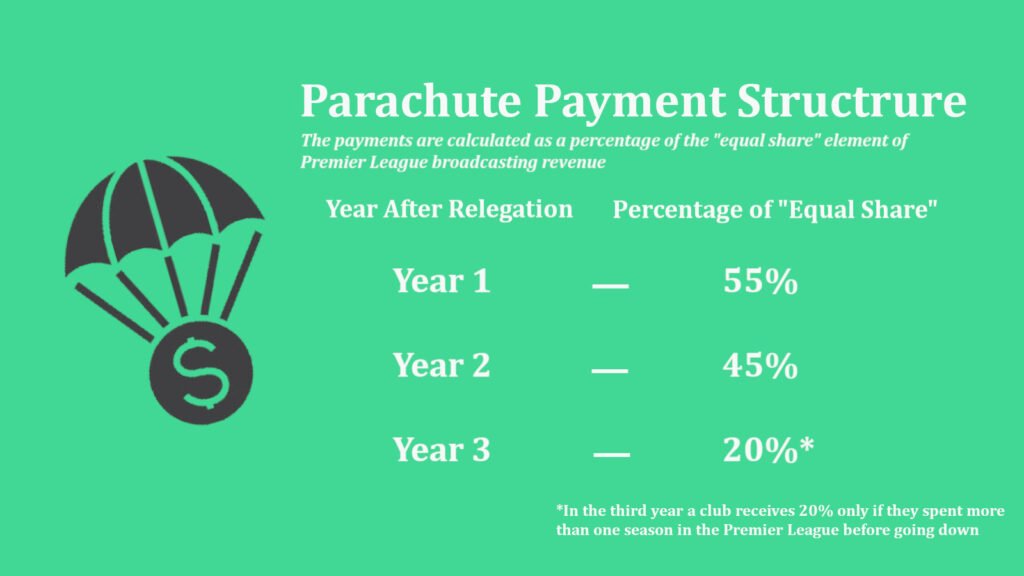
The payments are calculated as a percentage of the “equal share” element of Premier League broadcasting revenue – the portion that every top-flight club receives regardless of where they finish. That equal share currently sits at around £80 million per club per season, and the parachute payments are drawn from that pot.
To understand just how much is at stake – and why finishing position within the Premier League matters so significantly – it’s worth looking at how much each Premier League position is actually worth in prize money.
The percentage decreases year on year. In the first season after relegation, a club receives 55% of that equal share. In the second year, that drops to 45%. In the third year – and this is where a key condition applies – a club receives 20%, but only if they spent more than one season in the Premier League before going down.
For clubs that were only in the top flight for a single season, the payments stop after year two. Luton Town’s situation following their relegation in 2024 illustrates this exactly: having come up via the play-offs and gone straight back down, they received approximately £49 million in 2024/25 and will receive a further £40 million in 2025/26 – then nothing.
Clubs that go straight back up lose the payments immediately. That might sound harsh, but the logic is sensible enough; they no longer need the cushion because they’re back in the money. And there’s actually a financial incentive for the Premier League itself: when relegated clubs win promotion while still receiving payments, the top-flight clubs share those unspent funds between themselves.
How Much Money Do Relegated Clubs Receive From Parachute Payments?
The numbers are striking. In 2024/25, the three clubs relegated the previous season – Burnley, Sheffield United, and Luton Town – each received approximately £49 million in year-one payments alone. That figure is around 10% higher than the year before, reflecting the ongoing growth in Premier League broadcast income.
Over a full three-year cycle, a club that avoids immediate promotion could receive somewhere in the region of £90–100 million in total. That’s before you factor in the Premier League revenue they were already banking during their time in the top flight.
Some specific examples put the scale of this into sharp relief. Southampton, promoted via the play-offs in 2024 before being relegated again in 2025, stand to collect at least £140 million from parachute payments across their two relegation spells. Luton Town, a club that was playing non-league football just over a decade ago, were assured of more than £80 million in payments after their 2023 promotion – a figure that would have risen to £200 million had they avoided the drop. As one analyst put it, the total uplift from Luton’s promotion journey was potentially approaching £290 million. For a club of that size, those numbers are almost impossible to fully comprehend.
Zooming out further, the 2020/21 season saw total parachute payments of £233 million distributed across seven clubs at various stages of their payment cycle – averaging roughly £33 million each. At any one time, up to nine Championship clubs can be in receipt of the payments simultaneously.
Solidarity Payments: What the Rest of the EFL Receives
Not every Championship club gets parachute money – only those recently relegated from the Premier League. The other clubs receive what are called solidarity payments, a separate pot also funded by the Premier League and distributed across all 72 EFL clubs.
Solidarity payments are calculated as a percentage of what a third-year parachute recipient would receive. In the Championship, that works out at 30% of a year-three payment; in League One it’s 4.5%; and in League Two, 3%. In practical terms, Championship clubs without parachute eligibility receive around £5.5 million per season, while League One clubs get roughly £780,000 and League Two sides approximately £535,000.
The gap this creates within the Championship alone is enormous. A first-year parachute club is receiving upwards of £44 million; a non-parachute club in the same division gets around £5.5 million. That is a difference of more than £38 million between sides competing on the same pitch, in the same league, with the same promotion ambitions. As the EFL has pointed out, this disparity isn’t accidental – it is structurally built into the financial model of English football.
Why Parachute Payments Are Controversial: The “Yo-Yo Club” Problem
Parachute payments were designed to prevent financial collapse, and in that narrow sense, they work. But the problem is that they work too well in another direction entirely – they make it very easy for recently relegated clubs to come straight back up.
The statistics are damning. In each of the last six seasons before 2024/25, two of the three clubs promoted to the Premier League were receiving parachute payments. In practical terms, the Championship’s three promotion places have increasingly become a closed shop: two for the parachuted clubs, one for everyone else.
The 2024/25 season became a case study in this dynamic. All three promoted clubs the previous year (Leicester, Ipswich, and Southampton) were relegated straight back down, each now armed with substantial parachute payments for their return to the Championship. The cycle continues, with the same clubs bouncing between the two divisions, and genuinely promoted Championship sides – the ones who actually earned promotion on merit, without the financial advantage – finding it almost impossible to stay up.
Research from Sheffield Hallam University found that clubs without parachute payments were operating on average revenues of around £20 million per season during the same period that parachute clubs were pulling in £33 million or more. Parachute recipients, according to other analysis, are roughly three times more likely to win promotion back to the Premier League than their non-parachuted rivals.
The QPR case is worth noting as a cautionary tale on the other side of the argument. The club received £115 million in parachute payments between 2014 and 2019 following their relegation and still failed to win promotion, subsequently falling into severe financial difficulty. Money alone is not a guarantee of success – but having it is a massive head start.
The Future of Parachute Payments: Reform, Regulation, and What Comes Next
English football’s new independent regulator, established through the Football Governance Act in 2025, has parachute payments firmly in its sights. For the first time, the regulator has been given the power to impose conditions on how payments are distributed, and crucially, to step in if a binding agreement between the Premier League and EFL cannot be reached.
EFL chairman Rick Parry has long argued for the abolition of parachute payments altogether, calling for their replacement with a 25% share of pooled broadcast revenue distributed across all four divisions on a merit basis. The Premier League, unsurprisingly, has resisted this – though it did propose an additional £358 million over three years in late 2023, a deal ultimately rejected by EFL clubs who felt the conditions attached were unacceptable.
Academic research suggests parachute payments serve a genuine financial purpose for a maximum of two years after relegation. A model proposed by researchers at Birkbeck Sport Business Centre would reduce them to 25% of the Premier League’s equal share in both years one and two, with no third-year element – providing a genuine safety net without giving relegated clubs the financial firepower to dominate an entire division.
Whether reform comes through negotiation or regulatory intervention, one thing is clear: the current system is increasingly difficult to defend. It was built for a different era, when the gap between the Premier League and Championship was significant but not yet a chasm. Today, with broadcast revenues at historic highs and the gulf between the two divisions wider than it has ever been, parachute payments have grown from a sensible precaution into one of the most distorting financial forces in English football. The question is no longer whether reform is needed, it’s how radical that reform will eventually be.
Frequently Asked Questions About Premier League Parachute Payments
What are parachute payments in football? Parachute payments are sums of money paid by the Premier League to clubs that have been relegated to the Championship. They are designed to help clubs manage the sharp drop in broadcast revenue that comes with dropping out of the top flight, and are paid over up to three seasons on a sliding scale, starting at 55% of a Premier League club’s equal broadcast share in year one, dropping to 45% in year two, and 20% in year three.
How much do relegated Premier League clubs receive in parachute payments? The exact figure changes as broadcast deals are renegotiated, but in 2024/25 each newly relegated club received approximately £49 million in their first year. Over a full three-year cycle, a club can collect somewhere in the region of £90–100 million in total – though clubs promoted back to the Premier League during that period stop receiving payments immediately.
Which clubs currently receive Premier League parachute payments? At any one time, up to nine Championship clubs can be receiving parachute payments simultaneously, as the payments span up to three seasons. For 2025/26, Leicester City and Southampton – both relegated from the Premier League at the end of the 2024/25 season – will begin receiving their first-year payments of approximately £49 million each, joining any clubs still within their payment window from previous relegations.
References:
UK Parliament Publications — Football Governance Bill [HL] — EFL Submission (June 2025)
90min — What are Premier League parachute payments? (May 2024)